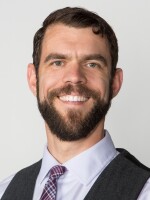
Kendrick Gaussoin remembers it all so clearly — the August day a decade ago when his dream of becoming a professional photographer suddenly collapsed.
He was driving to the Ventura, Calif., campus of Brooks Institute, the private, for-profit college where he'd been working on a bachelor's degree in photography. When he pulled up, he was surprised to find classmates and friends milling outside. The school's doors were chained.
"It was very eerie," he remembers. "Everyone was crying. Everyone felt like they'd lost everything."
Brooks had suddenly been shut down by its parent company, leaving Gaussoin and some of his classmates with enormous student loan debts and no clear path to a degree.
"I was completely discouraged," Gaussoin remembers. "I basically gave up, and I've spent the past nine years really just trying my best to move forward."
Today, though, Gaussoin is revisiting what happened to him at Brooks — and is trying to get his student loans erased.
For more than three decades, federal law has required the U.S. secretary of education to cancel the debts of qualified borrowers whose schools close suddenly, a process known as "closed school discharge." But a lawsuit filed Wednesday against the Department of Education claims the Trump administration is illegally refusing to fully follow all of the program's rules.
The lawsuit was filed in federal court by Student Defense, a nonprofit borrower advocacy group, on behalf of Gaussoin and potentially thousands of other borrowers.
The Education Department told NPR it stands by its implementation of the program.
How closed school discharge works
According to a review by the nonpartisan U.S. Government Accountability Office, between 2010 and 2020, more than 1,100 colleges closed, including Brooks, leaving 246,000 borrowers eligible for a closed school discharge.
To qualify for a traditional discharge, borrowers have to either 1) have been enrolled at the time of closure or 2) have left school no more than six months before the closure.
Gaussoin's school, Brooks Institute, closed in August 2016. But in December 2015, he took an eight-month leave of absence to work as a photographer. Because the school was closing as he returned, Gaussoin's leave put him beyond the program's standard look-back window. He had been away too long to have his loans discharged.
But nearly a decade later, in 2025, Gaussoin's luck appeared to change.
In the waning days of the Biden administration, the Education Department expanded the look-back window for borrowers who had attended several closed schools, including Brooks.
Under the change, any borrower who was enrolled as of May 6, 2015, would qualify for a loan discharge and refund of any past payments. Gaussoin was suddenly eligible.
In an order dated Jan. 6, 2025, the department's then-undersecretary, James Kvaal, wrote that the administration was expanding the window of eligibility because the schools had been closed under "exceptional circumstances," justifying more leniency for borrowers.
Denials under Trump
Gaussoin learned about the Biden-era change over the summer. On Aug. 23, 2026, he applied for his closed school discharge, noting in his application that he now falls within the new, expanded look-back window. A week later, in a letter dated Aug. 31, the Trump administration denied his request for loan forgiveness.
In the denial letter, Gaussoin was told he did not meet the traditional pre-Biden eligibility requirements. NPR asked the department why it appeared to be ignoring the Biden-era eligibility expansion, and Education Department spokesperson Ellen Keast responded with this statement:
"The Biden Administration was laser-focused on implementing unlawful policies to shift student loan debt onto the back of every single hardworking American taxpayer. Literally days before leaving office, the former Biden Under Secretary used the stroke of a (digital) pen to inappropriately expand the closed-school discharge period for certain institutions targeted by the previous Administration."
Viewing this authority as "unlawful" is new for a Trump Education Department.
In November 2019, during the first Trump administration, Education Secretary Betsy DeVos used the same authority, citing "exceptional circumstances," to expand the look-back window for borrowers who had attended the troubled Art Institute of Colorado and the Illinois Institute of Art.
"Students were failed and deserve to be made whole," DeVos said at the time. "By canceling these students' loans … as well as extending the closed school discharge period, we hope that these impacted students will now have the tools and resources they need to complete their education."
"Legally, the secretary has the authority to expand the window [of eligibility]," says Bonnie Latreille, a former top official in the office of Federal Student Aid (FSA) during the Biden administration. If the Trump administration is now trying to quietly ignore or revoke that rule change, Latreille says, "then I think that raises legal flags."
Latreille worked at FSA as the Education Department was transitioning between the Biden and Trump administrations. She says a top department official instructed her to not immediately process any closed school discharges using the expanded look-back window without approval from the incoming Trump team.
NPR spoke with two other former department officials who corroborated Latreille's story but who asked that NPR not use their names because they feared professional repercussions for speaking out.
In this week's lawsuit, attorneys at Student Defense argue that the Trump administration cannot simply ignore or abandon the Biden-era changes, because those changes were made well within the bounds of the department's legal authority.
Multiple higher education attorneys not associated with the case told NPR that if the Trump administration wants to reverse those changes, it would have to do what the Biden administration did: build a reasoned, legal explanation and then share that with the public.
The department did not respond to a request to share its legal justification for ignoring the Biden-era changes.
"This is a joke, right?"
Unbeknownst to Gaussoin, Brooks had been in trouble for years. Founded in 1945, the visual arts school was once well regarded. But after its sale in 1999, enrollment began to decline as borrowers accused Brooks of high-pressure sales tactics, lying about graduation and job placement rates and misleading students about the school's high cost.
Gaussoin's mother, Christine Gaussoin, took out Parent PLUS loans to pay for her son's education. She says the school led her to believe that her loans would be enough to cover Kendrick's costs at Brooks. The plan was for him to remain debt free.
"Then I get an email from the counselor," she remembers. "It says, 'We need more money.' And I was like, 'I'm tapped out.'"
At the time, Christine says she was living on disability while recovering from a total knee replacement.
"Then Kendrick calls me and says, 'I need you to write this letter that says I'm not your dependent anymore.' I was like, 'Really?' He's like, 'Yeah. I'm going to take out federal loans so I can finish the degree.'"
Christine pauses, remembering this conversation. "What is a mom to do?"
When Kendrick called his mother to tell her the schools' doors had been chained shut, she remembers thinking, "This is a joke, right? Really, this was a joke, because he had just taken out those federal loans, and I didn't know what to tell him."
For the past 10 years, Kendrick and his mother have both felt the weight of those loans.
He is now married with two young children and works for an online retailer. He's saddled with nearly $22,000 in student loan debt, including interest, but no degree.
"I've been working hard at just trying to survive off minimum wage," Kendrick says. "It's been really tough."
Christine says she also works in retail and owes about $28,000 that she worries she may never pay off, even though her debts also, technically, qualify for discharge under the Biden-era change. Her application for a closed school discharge was denied this month.
Christine says she regrets how she and her son fell for the promises of a troubled school.
"The school promised us that this was gonna be his ticket — to make the most money he will ever be able to [as a photographer]," she remembers.
Instead, a decade later, the school and the Gaussoins' unpaid debts are still holding them back.
Copyright 2026 NPR