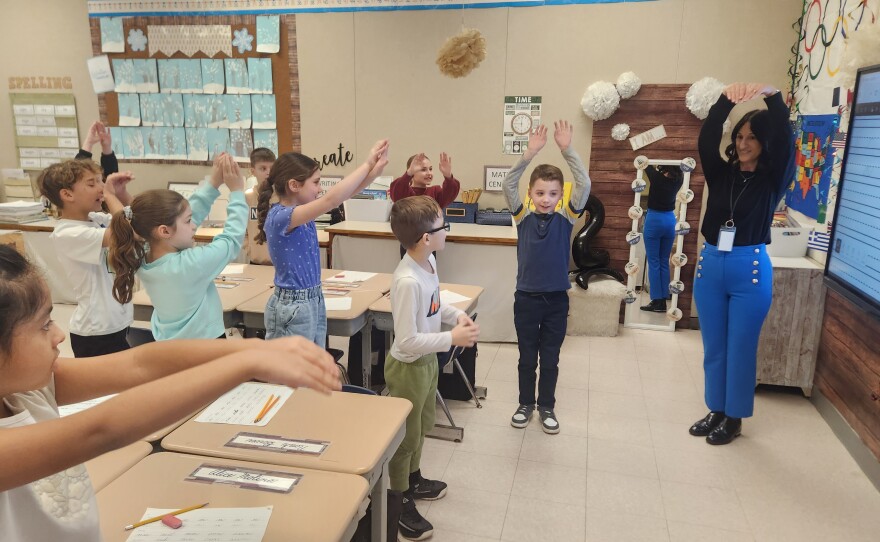
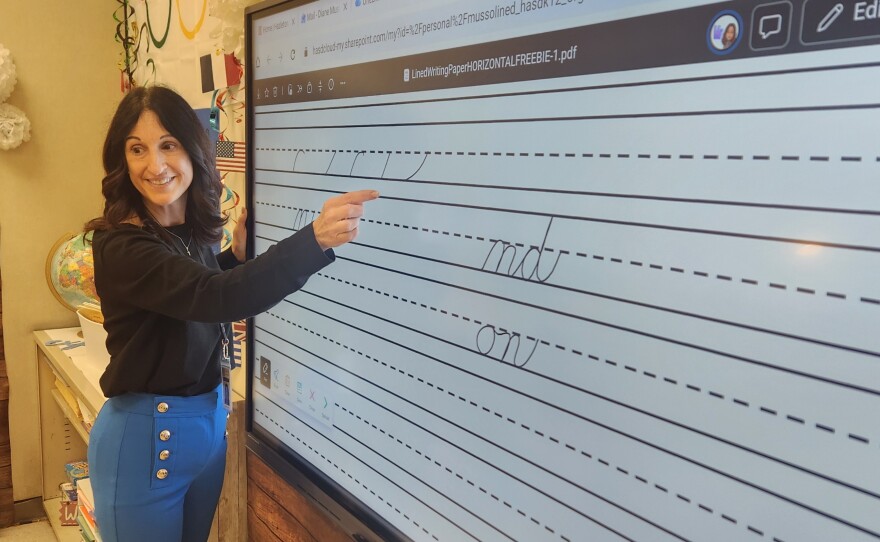
Second-grade students in Sugarloaf Twp. reviewed the steps for the cursive letter n.
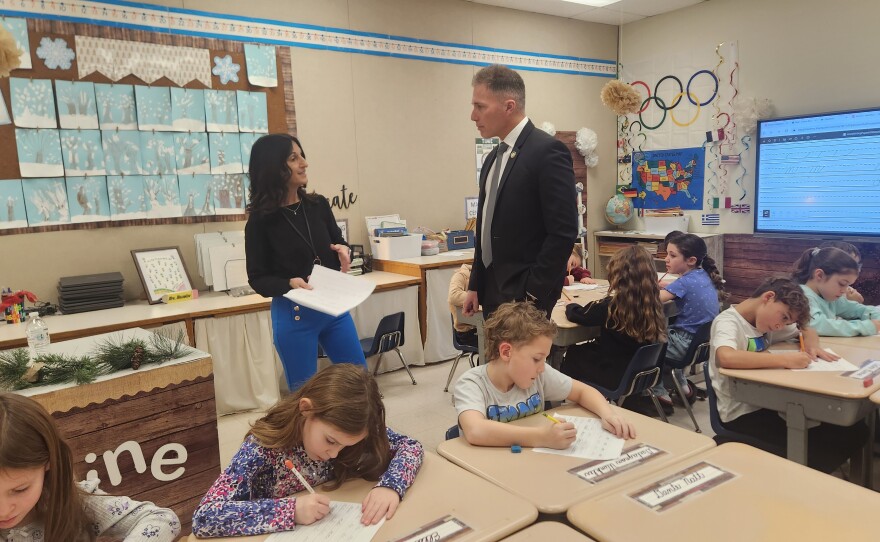
Overcurve, slant, overcurve, slant, undercurve, the students told state Rep. Dane Watro last week.
“I’m very happy to see this,” said the Republican from the 116th District, which encompasses parts of Luzerne and Schuylkill counties. “You all have beautiful handwriting.”

Soon, lessons similar to the one in Diane Mussoline’s classroom at Valley Elementary/Middle School will happen statewide.
Gov. Josh Shapiro signed Watro’s bill this month that requires elementary public and private schools to teach “joined italics and cursive handwriting.”
A growing number of states require the skill be taught. This comes after decades of many districts moving away from cursive as technology became more prevalent, and to spend more time in core subject areas.
“We have the Constitution, the Declaration of Independence, and we should be able to learn how to read it and write it,” Watro said. “But cursive is so much more than just writing it. It helps with cognitive development, and I just feel that this is something that could really advance our students at a young age, moving into the future.”
'Sense of pride'
Now-retired state Rep. Joe Adams, who represented parts of Wayne and Pike counties, first introduced a bill requiring schools to teach cursive in 2023. The former Western Wayne superintendent resigned from office a few months later.
Watro, now in his second term, decided to take up the cause.
He recalls the impact of his second-grade teacher at McAdoo Kelayres Elementary School, Paula Bodnar. She ensured that each of her students could read and write cursive.
“When I was able to write my name, I felt grown, mature, and you have a sense of pride and accomplishment,” Watro said. “And I think these students learning this here in the commonwealth … will have that same sense of pride and accomplishment in themselves, and they're going to feel good.”
The Hazleton Area School District, whose more than 14,000 students makes it one of the largest districts in the state, brought back cursive handwriting a few years ago. Students, including those in Mussoline’s classroom, improve fine motor skills and cognitive recognition as they learn cursive, Superintendent Brian Uplinger said. Learning how to sign their names or write a check is still an important skill, he said.
“We're grateful that there's legislation out there that will span the entire commonwealth, and then everybody across the commonwealth will be able to read and write in cursive,” Uplinger said. “So we're ecstatic that that's taking place.”

State to provide guidance
Watro’s bill, which passed with bipartisan support in the House and Senate, amends the Public School Code.
WHAT THE LAW SAYS
The law, which will go into effect in April, now states, in part:
'... the following subjects shall be taught, in the English language and from English texts: English, including spelling, reading [and], writing, including print, joined italics and cursive handwriting, arithmetic, geography, the history of the United States and of Pennsylvania, civics, including loyalty to the State and National Government, safety education, and the humane treatment of birds and animals, health, including physical education, and physiology, music and art.'
The Pennsylvania Department of Education is now developing guidance for schools. Many have continued to include cursive writing in their curriculum, while others will need time and support to incorporate it into their schedules.
“Our priority is to provide practical assistance and clear expectations so teachers can focus on students and learning,” according to a statement from the department.
With the end of the school year approaching when the law goes into effect in April, schools that need to incorporate cursive writing into their curriculum will most likely plan for implementation in the next school year, according to PDE.
Across Northeast and Central Pennsylvania, whether students are exposed to cursive handwriting — and how much — varies greatly. The Lake-Lehman School District in Luzerne County, where students learn to write it in second grade and practice it in third grade, has had three national handwriting champions since 2020.
As of last year, 25 states require cursive to be taught in schools, according to My Cursive, a site that offers handwriting resources.
Practicing cursive
Back in Mussoline’s classroom, students watch as Watro writes his name in cursive neatly on the board.
Even when the district didn’t require it, the veteran teacher never stopped teaching her second graders how to write in cursive. She often turns on music to make her students relax.
“Your hand should be flowing across the page,” she said. “Don't get discouraged … The first time you're going to make mistakes. It’s OK. But practice makes better, right?”
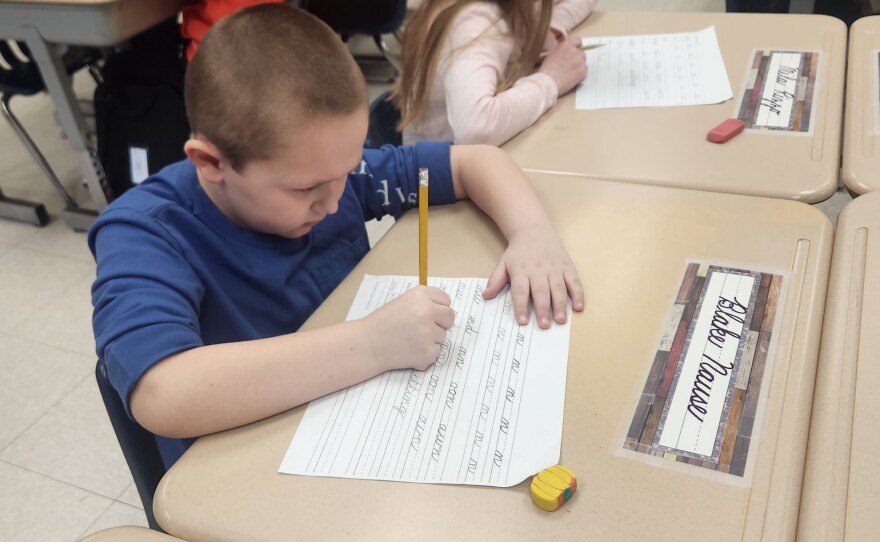
Blake Nause, 8, repeated the letter n at his desk.
“It's so cool, and I like how the letters connect,” he said.