

A decade ago Lexie Kelly left the Abington Community Library confused. She was there to learn how to play mah-jongg.
"I purchased a book and then my friends got involved, and we all sort of learned it together," she said.
It took her about two years to really learn the game played with ornate tiles on colorful mats — and its pace.
Now she reads rule books for fun. In October, Kelly, along with Laurie Gumula started the Mah Jongg Social Club of NEPA.
"It's a way to socialize, and you can pick your favorite color, and you can make a table scape and kind of express yourself, but it's way to sit around the table and have a conversation. You're not on your telephone, you're not on social media," she said while setting up to teach at Corky's Garden Path in Scott Twp., Lackawanna County.
When they’re not teaching, Kelly and Gumula have their own team.
"We play every Wednesday night. We've seen our kids apply to college, graduate from high school, graduate from college. We've been through that," Kelly and Gumula said. "We've lost our parents. We've had a couple of divorces. I mean, it's all about supporting one another and there's a benefit to that, health wise, when you are socializing too.”
NPR reports the game has seen increased interest specifically among Gen Z and Millennials over the last year. Eventbrite reports there was a 179% increase in U.S. mah-jongg events on its platform from 2023 to 2024, according to the Associated Press.
That trend has made it to Northeast Pennsylvania. The club’s first tournament had 40 players.
Then they started offering lessons, which are capped at 12 players. There’s also open play which Kelly said is not quite as structured.
"I am just surprised at how many people called us and wanted to learn. We knew that it was growing and that it was popping. And if you look at the history of mah-jongg in the 1920s it popped, and people used it to entertain, and they did menus around it, and they dressed up for it, and it became a whole event,” she said.

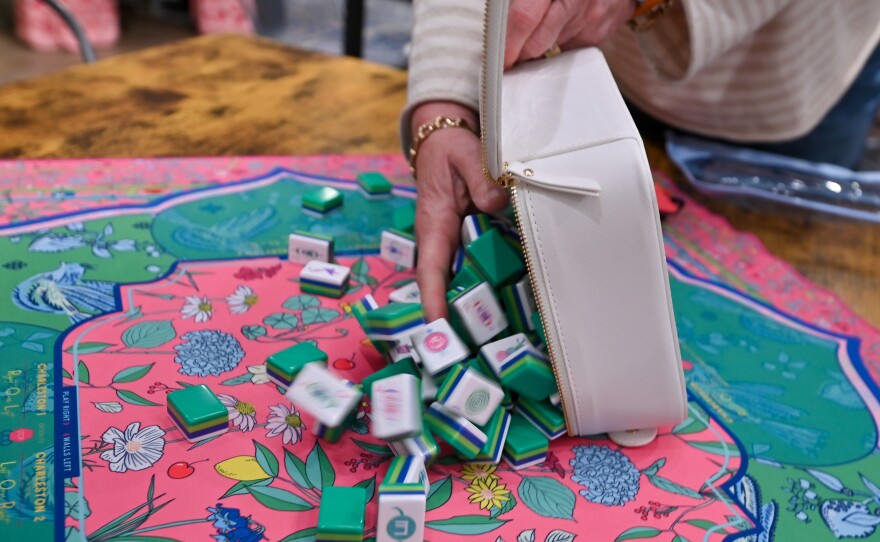


Cracking, colorful tiles
In the back of Corky’s Garden Path, Kelly and Gumula laid out square mats in jewel tones and pastels. The mats have floral details, lemons and birds.
They dumped the tiles onto the mats which made a cracking sound as they bounced off one another. That sound is the reason for the game’s name which translates to “sparrow.” The cracking resembles the birds’ chirp.
American Mah-Jongg is played with 152 tiles with three suits — bams, short for bamboo, cracks, short for characters, and dots. There’s the directional tiles, called winds, which in the game spells out NEWS — north, east, west and south.
Then there’s also honor suits like dragons, flowers and, in American Mah-jongg, joker tiles.

The 152 tiles are built into walls in front of each player. It’s a four-player game so 38 tiles, 19 tiles long by two high.
"You break the wall like you would break a deck of cards, and each player gets 13 tiles," Kelly said.
A die is rolled to determine where the wall is cracked.
Then players work through picking up and disposing of tiles to make mah-jongg, which is a complete set of 14 tiles melded together.
"Part of the strategy is figuring out what your opponents are playing," Kelly said.
For those who are first learning to play one game could take up to an hour, she said.
"It's all about practice. And the more you practice, the more accustomed you get to recognizing the tiles and the patterns and the suits, and the faster your mind can organize it," Kelly said.
On April 1 of each year the National Mah Jongg League puts out a card that has the winning hands for each year. There’s 55 hands but Kelly said there are 1,000 different ways to win by finding that complete set of 14 tiles.
"The hardest part about mah-jongg is learning to decode the card,” she said.
At Corky’s, the ladies sold the cards. The national league is philanthropic and the money from the cards goes back to a charity. Locally this year, the funding goes to the Ronald McDonald House.

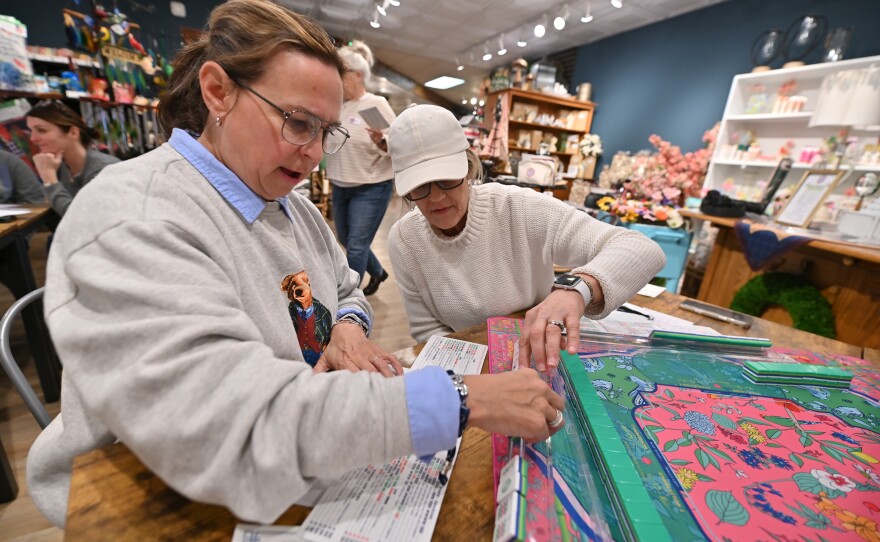
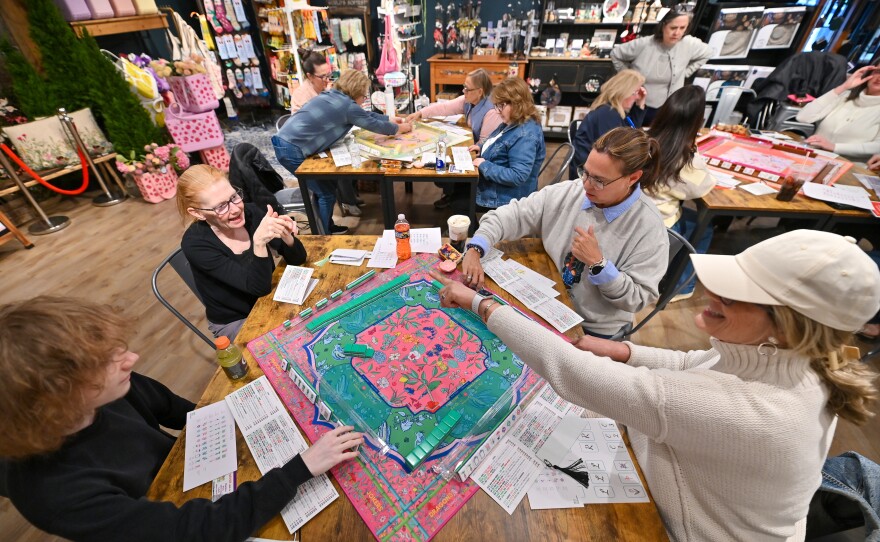

The standardization of American Mah-Jongg
The game in American standards is spelled “mah-jongg.” It originated in China in the 1800s. Kelly said there’s lore that Chinese sailors replaced wet playing cards with tiles made of bamboo.
A man named Joseph Park Babcock worked for Standard Oil and brought the game to the United States in 1920. He spent time with the company in Shanghai and learned how to play. Babcock trademarked the spelling "mah-Jongg."
"Most people are drawn to the tiles because they're beautiful. So he thought he would bring them to the U.S. and see if people like them. And they did," Kelly said. "So people in San Francisco started playing. It moved to New York. It moved to Florida.”
But Kelly, who loves the history of the game, said there was a problem. There were no written instructions. Players had to learn from someone.
"And by the 1930s the people in Florida couldn't play with the people in San Francisco. It's like the game of telephone. There were so many house rules and table rules,” she said.
One of the women practicing at Corky’s said her mom played “Hilton Head rules.”
In 1937 a group of women in New York City put an ad in The New York Times asking if anyone would like to standardize the rules for mah-jongg.
"And the National Mah Jongg League was born. So it's in the U.S. It's women supporting women and socializing, and it's just like a really nice thing,” Kelly said.
With the rise in popularity, Kelly believes history is repeating itself.
"Whether the common denominator is COVID versus the 1918 influenza, I don't know," she said. "But the same thing is happening today.”

'Brain bending'
Kelly said the game helps with dementia, Alzheimer's or memory loss as people age.
"It's a really good exercise for your mind," she said.
Kiernan Riley played at one of four tables at the Hilton Scranton & Conference Center’s Casey’s Corner during a social club tournament.
She called mah-jongg “brain bending.”
"So for me, it's like fun for my brain, because it's very difficult," she said. "It makes it hard to learn. So I feel like the more I learn, the more I'm like, accomplishing everything."
The league hosts open play nights once a month at the Hilton and the Waverly Country Club.
In Scranton, more than 16 players of all ages made connections with each other and celebrated when opponents found mah-jongg. On the other side of the restaurant, Kelly walked newbies through a slower version.
Bridget Walsh from Clarks Summit learned to play this past summer with her sisters and friends.
"We wanted to see how well we paired up with others,” Walsh said, interrupting her answer to call out “seven dot," referencing the tile she had collected.
“To see if we were as good or better than other people,” she continued.
She said Gumula complimented her team on knowing the rules, including that during a tournament players are only supposed to play with one hand.
"So I feel like the fact that Laurie was like, ‘Oh, you guys know the rules’ felt like being complimented by the master,” Walsh said.
Loryn Copley joined the club in February. She grew up playing competitive games and finds mah-jongg challenging.
"Everybody is so incredibly nice, whether you are playing for years or like myself,” she said.
One the players recently invited Coply over to walk her through how the game is played.
“I didn't ask too many questions, because I just was absorbing it, because there's a lot to learn," she said. "It's like a combination of chess, combination of poker, you know, all the heavy duty games.”
Coply said when she started playing, she couldn’t sleep.
"I just kept thinking about the tiles and thinking about the matches, and then I was dreaming about it," she said.
In her waking life, she enjoys the social aspect of the game.
“After a long day's work, we come out, we play a couple rounds, and it's just fantastic,” Coply said.
Opportunities for mah-jongg in Northeast and Northcentral Pennsylvania
The Mah Jongg Social Club of NEPA hosts two open play nights a month.
Upcoming events include:
- The Hilton Scranton & Conference Club: Tuesday, May 12, and Tuesday, June 9.
- The Waverly County Club, Waverly: Tuesday, May 19 and Tuesday, June 16.
- The club's next four-class series of lessons begins on June 4 from 5:30 to 8 p.m.
To register or for more details, visit mahjonggsocialclub.com
Other chances to play include:
- Orwigsburg Free Public Library, Fridays from 1 to 3 p.m., and the first, third and fifth Wednesday of each month at 6 p.m., 216 West Independence St., Orwigsburg.
- Mah Jongg at Temple Israel of the Poconos, Tuesdays, 10 a.m. to noon, 711 Wallace Street, Stroudsburg.
- Public Library for Union County, May 5, 12, 19 and 26 from 1 to 3:30 p.m., and 6 to 8 p.m.; those interested should register by calling 570-523-1172, visiting the library or registering online.
- Clymer Library, every second and fourth Friday of the month, 1 to 2:30 p.m., 115 Firehouse Road, Pocono Pines; registration required at the library or by calling 570-646-0826.
- Palmerton Area Library, Tuesdays from 1 to 3 p.m. and Thursdays from 4:30 to 6:30 p.m., 402 Delaware Ave., Palmerton.
