For Maud Dahme, survival meant staying hidden. She was 6 and her sister 4 when their parents sent them away.
“My father gave me the two little suitcases, and he said, ‘Maude, we'll see you in a couple of weeks.’ And he said, ‘Take very good care of your little sister and have a good time,’” Dahme, now 90, told students in Scranton on Tuesday.
Dahme and her sister relied on the kindness of Christian resisters, who helped the Jewish children hide on farms and other locations for several years, as the Nazis invaded the Netherlands and sent Jews to concentration camps.
She could hear the bombings and had to be mindful of the soldiers on patrol. She sometimes ate bugs and tulip bulbs to survive. Dahme went decades without telling her story.
“I never spoke about it, because after the war, everyone was saying it's over, life has to go on,” she said. “So no one talked about it.”
She began sharing her story in the 1980s, after she heard comments from someone who denied the Holocaust happened.

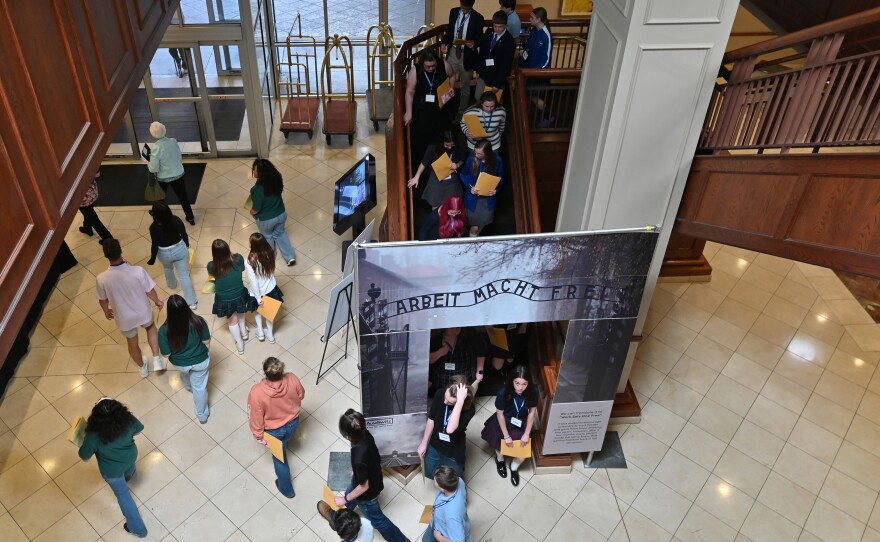
This week, 1,400 students from around the region are hearing her story and the stories of other survivors. Some of those stories are told by the survivors themselves — but 80 years after the end of World War II, most of those stories are told from video, or the second or third generation.
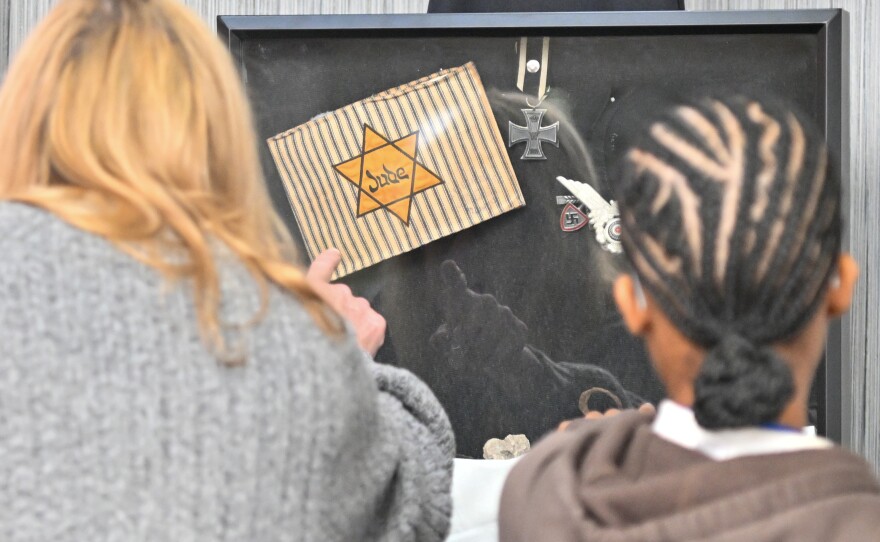
“It's such an important topic and one that needs to be told,” said Susan Blum Connors, a volunteer for the 38th annual Teen Symposium on the Holocaust, held at the Hilton Scranton and Conference Center. “We bear witness now by listening to these survivors. We bear witness to what happened to prove that it did for all the deniers out there. Antisemitic crimes are on the rise. It's terrible. So it becomes more important every year.”
Lasting impact
Anthony Massa was in eighth grade in 1995 when Ruth Kapp Hartz visited his school in Northeast Philadelphia.

She told the students about how as a 4-year-old, she and her family went into hiding in France. They changed her name to Renee to disguise her Jewish identity, as she hid on a farm and eventually in a Catholic convent.
More than 30 years after she visited the school in Philadelphia, her story still sticks with Massa, now a history and civics teacher at East Stroudsburg High School North. On Tuesday, he brought some of his students to hear Hartz speak in Scranton.
“It was a full circle moment for me to see my students get to hear her speak in the same way that I got to hear her speak,” Massa said. “It is incredibly important. There's growing hate and antisemitism in this world, and there's growing Holocaust denial, unfortunately. So these stories are just as important now as they ever were, and the oral histories are incredibly important. People need to hear first-hand accounts.”
Massa and his students posed for a photo with Hartz after her session.
“I'm very glad that she's able to come,” said senior Dylan Krumanocker. “That's a very important thing that needs to be talked about, and people should know.”

Realizing the importance
Dahme and her sister reunited with their parents after the war. Her parents lived in an attic for three years to avoid capture. Most of their extended family, including three grandparents, an aunt, uncle and cousins, were murdered by the Nazis at the Sobibor death camp.
The family moved to America in 1950. Dahme leads an annual tour of Holocaust sites in Europe and last year, received the royal decoration of knight in the Netherlands, in recognition of her commitment to Holocaust education.
About 800 students attended the symposium on Tuesday, and another 600 will attend Wednesday. The event is coordinated through the Holocaust Education Resource Center of the Jewish Federation of Northeastern Pennsylvania.
“I always say to the kids the impact this has on them may not be felt today or tomorrow, but somewhere down the line, all of a sudden, they're going to think about what they heard here and realize how important it was,” Connors said.