

When PBS President Paula Kerger checked into a Scranton hotel a woman at the front desk asked her what she does for a living.
“I said ‘Oh, I work at PBS,” Kerger recalled.
The hotel employee, who said she grew up on PBS Kids programs, replied: “it was so sad that you're gone away.”
“I said ‘no, we’re still here and thanks to viewers like you,” Kerger told a crowd at WVIA studios in Jenkins Twp. Wednesday evening.
Kerger visited WVIA for at least the second time in her 20-year tenure as the head of PBS. She spoke on a panel for the station’s Conversation for the Common Good with WVIA President and CEO Carla McCabe and moderated by Anna Quindlen, a bestselling author and Pulitzer Prize-winning journalist.
The panel discussion focused on public broadcasting and its future.
"I believe it is these moments when we've had to look very carefully at who we are and what we do, and out of that we make the decision that we are here for the public interest, and you know what, the public is behind us,” Kerger said.
Before the conversation, which will air on WVIA-TV in July, Kerger spent the day at the public media station, which serves 22 counties in Northeast and Northcentral Pennsylvania. She spoke to the staff and learned from members of the community about why WVIA is important to them and a cause worth supporting.
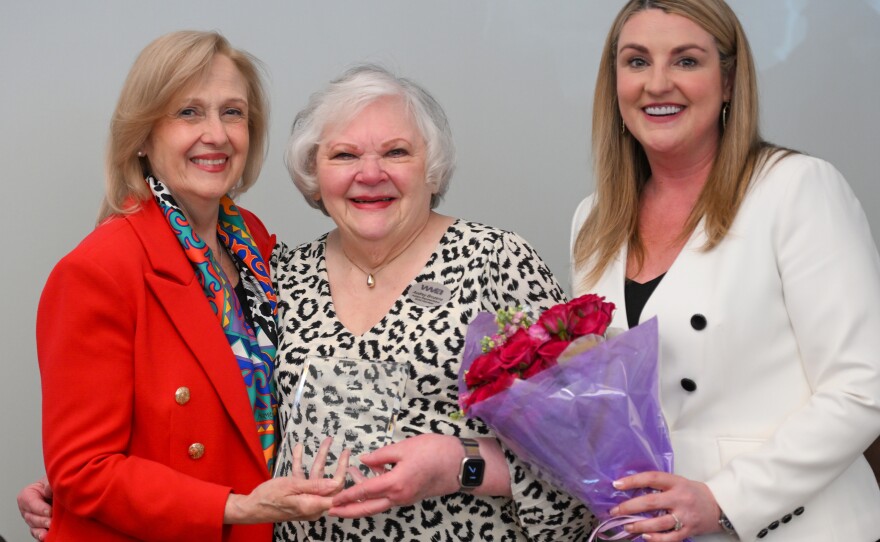
She even surprised longtime station volunteer Audrey Brozena with a Legacy of Service Award.
Brozena, who has volunteered with WVIA for 30 years, was tearful and speechless.

Federal funding loss
In July 2025, the U.S. Congress rescinded $1.1 billion in advance funding for the Corporation for Public Broadcasting (CPB). The corporation — which Kerger believes the Scranton hotel employee was referencing — funded both public television and public radio across the country. CPB dissolved after the funding was rescinded.
WVIA is a dual licensee, meaning the station offers both television and radio, along with digital platforms. WVIA lost 20% of its yearly operating budget after federal support was cut off.
Kerger said it’s an interesting period for public broadcasting, not only because of the funding loss but because it’s a time of tremendous change for how people consume media.
But there are now one million new donors to public media since the rescission vote, Kerger said.
"And of those, 60% are people that are giving every month as sustainers,” she said. “They understand, as I know everyone in this audience, and people watching, what viewers like you really means. That's why I'm so optimistic and so bullish.”
WVIA is at an all-time high with over 17,000 members, McCabe said.
Enriching spirits
President Lyndon B. Johnson signed the Public Broadcasting Act of 1967 into law on Nov. 7, 1967.
“While we work every day to produce new goods and to create new wealth, we want most of all to enrich man's spirit. That is the purpose of this act,” the 36th president of the United States said before signing the law. “It will give a wider and, I think, stronger voice to educational radio and television by providing new funds for broadcast facilities.”
WVIA-TV was already on air for a year at that point. WVIA Radio hit the airwaves in 1973.
"But in communities across this country, particularly rural and small towns, they had a right to have public media, he [Johnson] was aware of that from his days back as a teacher in a small town in Texas,” Kerger said. “He knew that town would never have a television station unless there was some government support.”
But in the years since, Kerger said how PBS was funded became confusing for viewers. Many thought it was completely government-funded, or it’s part of their cable bills.
"Even though we said time and time again, ‘thanks to viewers like you,’” she said. “After the defunding, people were like, ‘oh, that means me,’ and those are the people that are beginning to step up,” she said.
McCabe said the defunding was a wakeup call.
"We need to let the community know that we won't exist without their support,” she said. “We exist because of the community. We are a community licensee. We don't receive state funding. Now we don't receive federal funding. The community is why we are here.”
McCabe said local content is WVIA’s priority, because the station is a reflection of the 22 counties that it serves.
"The public, the communities are at the center of everything that we do, and that has to always be our mentality,” she said.

The future of public broadcasting
Quindlen read Kerger a sentence that was pulled from an editorial that ran in response to Kerger’s remarks at the PBS annual conference.
“What does public media provide that YouTube, TikTok, Netflix, Substack, or Spotify cannot? The answer cannot simply be trusted content. Every platform claims trust,” she read to Kerger.
Kerger said she feels like she’s back in the battle with cable channels. She said what PBS does is different from almost all of those mentioned platforms.
"We start every day just really thinking about how can we serve the public. None of the platforms you talked about, believe me, spend a moment thinking about what will make this country or communities better," she said.
PBS would love for viewers to be supporters but the organization is not selling a subscription for information, but it’s free for people across the country, no matter what, Kerger said.
"We're going to give it to you whether to subscribe or not. We want to make sure that we have an informed citizenry, we want, we want to create content that would be hopefully entertaining, but educational, inspirational,” she said. “That was the whole vision of it.”
Still, that content is changing shape because of online platforms like YouTube and social media.
"I love, I love, I love, I love short stories, I love documentary shorts, but it was always hard for us to schedule those because they don't really fit together, but to be able to watch them on their own merit, which we can do now in the way that we're distributing, that's really powerful,” she said.
Kerger also wants to encourage the next generation of filmmakers and storytellers.
At WVIA, McCabe said the station still has a robust television audience that she wants to nurture, while also working on digital-first content, and supporting the development of its journalism team.
"I don't think we can be everywhere and do it really well with the limited staff and resources. So, I'd rather excel in certain spaces that we know we can and just capture that audience, speak to that audience," she said. "And I think a key component, as well, is a lot of the films that we do, the longer form documentaries, we always try to tie education to it as well.”
Quindlen asked McCabe her thoughts on another passage of the editorial, which suggests local public broadcasting stations need to change and work together.
McCabe agreed, and pointed out that WVIA does have partnerships with other public media organizations in the state.
"I think it's an opportunity now for us to really come together and rethink what public media can look like, and how do we serve Pennsylvania," she said.
McCabe said beyond the other public media stations, partnerships are also key at the locally. She pointed to WVIA’s Sports Voices podcasts with FOX56 and Good Natured with DiscoverNEPA.
"We just need to get creative … we don't need to do it all ourselves. We don't need to reinvent the wheel. We just need to work together and be open-minded and partnered,” she said.
'Here to serve the community'
McCabe said her number one priority is to ensure that the station can keep its team intact.
"We've done a really good job over the last number of years to ensure that we build and have the right team in place for local productions, for local journalism, for education, and for arts and culture, and I don't want to lose that,” she said. “We're going to lose the local if we lose our people."
For Kerger, she wants to make sure that the PBS of the future is supporting the system of the future, which will be different.
She reiterated that WVIA is owned by the community and run by people who live in Northeastern and Northcentral Pennsylvania.
"In this day and age, that is profound, and it is absolutely fundamental to why people trust us," she said, "because they believe that this station exists because it is here to serve the community, and this is what we have to make sure that we're supporting more than anything else."
