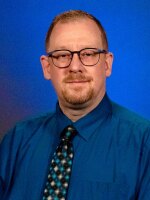
George Graham typically arrives at work after most of the staff has gone home.
He's been known to leave WVIA's Jenkins Township studios around the time the first early birds start to come in, passing like ships in the night.
For over half a century, the inveterate night owl has often toiled alone into the wee hours, wearing the hats of engineer, radio host and a producer eager to bring local music performers to area audiences.
Last Tuesday night was different.
When Graham walked through the employee entrance, much of the public broadcasting station’s staff was still there, waiting for him.
Dozens more guests were soon to arrive for a party and live music concert in the style Graham had so often organized himself.

“We just wanted to show our appreciation, and unveil this,” WVIA President and CEO Carla McCabe said as a curtain dropped and the corridor erupted into applause for the man she called "a complete community treasure."
Graham’s face beamed down upon the crowd from a placard commemorating his 53 years of service to WVIA.
The formal chapter of that service is coming to an end. Graham is retiring, and his last broadcast will air Jan. 2.
Graham, who joined WVIA Radio in 1972 during its design and construction, “flipped the switch” for WVIA-FM's first broadcast on April 23, 1973.
He turned 75 on Saturday.
As the applause quieted down, Graham explained that he plans to continue volunteering for the station after retirement.
“Some people, you know, just look forward to retiring,” Graham said. “Me? I just … you know … this organization’s in my DNA.”

Carbondale born and raised
Northeast Pennsylvania also runs deep in Graham's DNA.
He was born and raised in Carbondale, a son of the late George B. and Carmen S. Graham, and has one brother.
"I come from a small family. Both parents are passed away," he said.
Graham's father was born in Wilkes-Barre, son of George S. Graham, then master mechanic for the Delaware & Hudson Railway's Pennsylvania division. The grandfather's rise through the railroad's ranks eventually took him to Carbondale, where the family settled.
Transportation also brought Graham's parents together, albeit in a faraway place.
"It's an interesting story. My mother and my father happened to be together on a bus in Texas, and they met," Graham recalled.
She was from Mexico. He was visiting from Pennsylvania.
"She hardly spoke any English, he hardly spoke any Spanish, but they hit it off," Graham said.
He recalls a childhood trip to visit his mom's hometown.
"I remember when I was growing up, they literally drove the old Lincoln from Carbondale to Cuernavaca, Mexico — which is not near the border, it's central Mexico, near Mexico City, well over 3,000 miles," he said.
In those pre-interstate highway days, "it took nearly a week to drive there," Graham said.
A journey, and a homecoming
Life would take young Graham on another journey. He left home after high school to attend Duke University, where he majored in electrical engineering.
While there, Graham also got "heavily involved" with the campus radio station, WDBS.
It was then a campus-restricted AM station, but Graham and his colleagues knew FM broadcasting was on the rise — and particularly favored by music aficionados who were passionate about sound quality.
"We had a bunch of ambitious and interesting people, many of whom had major market broadcast experience. And we put together a proposal and took out a loan from the university to buy an FM channel, a commercial station," he said.
"And so I was involved with the actual engineering and getting that station on the air," he said.
That process involved a legendary "all-nighter" that Graham described last week, and previously during a 2019 VIA Short Takes interview.
"We actually took the transmitter out of the old commercial station building, pulled it across town, set it up, got it on the air by the next morning," he said.
For Graham, who graduated from Duke in 1972, returning to Northeast Pennsylvania wasn't the plan in those heady days.
"Actually, I thought I was going to stay in North Carolina," he said. "You know, our college station was doing what it was doing, and I was having a lot of fun there."
While back home that summer, Graham decided to visit some broadcasters in the area.
WVIA, which had begun television broadcasting in 1966, was preparing to launch an FM radio station.
"I happened to walk in and, you know, introduce myself," Graham said.
The newly minted electrical engineering graduate was in luck: The late Paul Evanosky, then chief engineer, told Graham WVIA had an engineering opening for the radio station.
For the second time in his young life, Graham would find himself at the heart of setting up a new radio station.
"So I just kind of walked into the job," he said. "Very good timing, very fortunate timing."


'My passions were electronics and music'
It didn't take long before Graham was hosting a music show on the new station — "Mixed Bag," which debuted as a weekly 90-minute program in June 1973.
"Growing up, my passions were electronics and music," he said.
Graham clarifies: His passion was appreciating music more than playing it.
"I had a number of years of piano lessons. I consider myself a failed pianist — you know, I can sort of read music, but I'm really badly out of practice," Graham said with a smile.
"So this gave me an opportunity to realize music through my efforts with others," he said of his work at WVIA.
As he wrote in a 2004 retrospective (which also includes the first show's playlist), Graham was "fired with an enthusiasm for the creative progressive rock that was very much part of the Woodstock era, but which was completely absent from the commercial airwaves in Northeastern Pennsylvania."
"Though a few college stations were doing that kind of music, I was out to try to bring it to these parts," Graham wrote.
Management gave him the green light, and the show took off. After 49 weekly shows, "Mixed Bag" became a daily Monday-Friday program on May 13, 1974.
In 1976 he launched a second program, "All that Jazz."
The same year, Graham started including local music performances on his "Mixed Bag" shows. That led to the creation of the "Homegrown Music" concert series in 1982, with live studio audiences present for several tapings throughout the year.

'This day was gonna come'
Tuesday night's multi-act concert, dubbed "George's Jam," had the feel of a "Homegrown Music" gig. It also rekindled the spirit of those early days in more ways than one.
Wilkes-Barre singer/songwriter Don Shappelle stepped up to the mic for the first set, toting the same guitar he did when he first appeared on "Mixed Bag" in 1976. This was the latest of 34 appearances Shappelle said he has made at WVIA, and presumably the last with Graham.
"I kind of always knew that this day was gonna come," Shappelle said. "But in a way I never thought it was gonna happen."
"I'd like to thank George for his lifelong support and devotion to the musical community of Northeastern Pennsylvania and Central Pennsylvania, and way beyond that also," Shappelle said.
Those remarks, and the choice of guitar, hit home for Graham.
"I'm glad that he did that," Graham said a few days later, looking back on the concert.
"You know, I knew that this is going to be the last big production like that in the studio that I would be centrally part of," he added. "So, yes, it was bittersweet."
GEORGE'S PLAYLIST
George Graham may be associated in listeners' minds with eclectic new music and local talent, but what does he listen to away from the studio?
In no particular order, here are the 10 albums Graham said he tends to go to "when I have had free time and was not auditioning new releases."
● Miles Davis: "Birth of the Cool"
● Miles Davis: "Kind of Blue"
● Oliver Nelson: "Blues and the Abstract Truth"
● The Beatles: "Sgt. Pepper's Lonely Hearts Club Band"
● Joni Mitchell: "Hejira"
● Donald Fagen: "The Nightfly"
● Louis Winsberg: "Jaleo" (French flamenco/jazz-rock fusion)
● Bobby McFerrin: "VOCAbuLaries" (amazing vocal layering)
● "Merchants of Venus" (eponymous) (Obscure melodic rock band with some of the best production in the genre)
● Pat Metheny Group: "Letter from Home"
'He's touched a lot of people's lives'
Shappelle was among thousands of people who performed on Graham's concerts over nearly 50 years.
"When you pick out all the band members, probably over 2,000 maybe 2,500 [people], something like that," Graham said.
Freeland native Jim Della Croce, a music industry publicist, producer and manager whose clients have included The Beach Boys and Martina McBride, also attended Tuesday's party and concert.
"In his way, George is a barometer. First, I really think his taste in what is great — as opposed to what is good — is really on the highest level," Della Croce said.
"But as a record producer and a creator, I have to say he's touched a lot of people's lives," he added.
One of those people, Della Croce said, was Bill Kelly. The West Wyoming native rose to prominence as lead singer of The Buoys, whose hit song "Timothy" climbed to 17 on U.S. charts in 1971.
Kelly and bandmate Jerry Hludzik would later form The Jerry-Kelly Band, which evolved into Dakota and opened for Queen during the legendary rockers' 1980-81 "The Game Tour."
As recounted in a WVIA "Keystone Edition Arts" discussion following Kelly's death last December, "Dakota’s WVIA Homegrown Music recordings played a pivotal role in advancing the group’s career."
"Jerry Hludzik and Bill Kelly were clients of mine, and dear old friends," Della Croce said last week, adding that Kelly later worked for his Pathfinder Management company after moving to Nashville.
Kelly, he said, "spoke so dearly of George that he felt like [Dakota's success] wouldn't have happened without that extra bit of moral support that George lent."
"So not only does he have the musical taste, but he has the heart and soul to be positive and promote great music," Della Croce said of Graham.
But, he added, Graham was always discerning in his selections. If he didn't see the value in a work, he wouldn't play it.
"I often would pitch George records or projects as a publicist, and that didn't mean he played them, [just] because we were friends," Della Croce said. "His credibility was on a high level."
"George is, as I said, is a barometer, and he's true north to me in the music business," Della Croce said.

'There's a humility about him'
In 53 years at WVIA, Graham has seen colleagues come and go.
He's left an impression on many, especially those who have spent decades at the station themselves.
Host and producer Lisa Mazzarella has worked at WVIA for 32 years.
"The thing about George is that he's very quiet and he's very unassuming," Mazzarella said.
"There's a humility about him, but there is a terrific strength that he has, and he doesn't make a big deal out of it," she added. "He just is a powerhouse and a force that you really can't reckon with. He's sharp."
WVIA Chief Content Officer and Executive Producer Ben Payavis II, who has been with the station 30 years, said Graham's skills have benefited radio and television productions alike.
"He has this incredible ear for music, but he also has the knowledge to be an audio engineer," Payavis said.
Graham, he said, has been known to easily untangle technical conundrums that would stump experienced video editors.
"They'd be struggling, trying to EQ [equalize] a certain frequency out. And George would walk in the room and say, 'Well, this is at 500 megahertz. Let's just bring that down 10 dB, and that should clean it up,'" Payavis said. "He has those golden ears. He's kind of the go-to person here in our organization."
Depending on the hour, that is.
"There's times where, you know, most of us would not see him, because he would come in the building at 7 p.m.," Payavis said.
'He's like a big brother'
Senior Producer and program host Erika Funke, who has worked at WVIA since 1978, recalled how Graham's technical skills and odd hours could intersect in humorous ways, especially in the days of tape-recorded programming run by automated machinery.

"The automation had a lot of working parts, and it would act up an awful lot, and it would act up during the day when George wasn't here," Funke said. "George had to sleep in because he would work until four o'clock in the morning. So you aren't going call him at nine in the morning."
The team would find ways to make due until Graham arrived, then ask him to diagnose the issue.
"George would walk in, as he always did, calmly. And then George would calmly go over to the interface. He'd look at the machine, and, he'd go, 'boom, boom, boom, boom, boom, boom,'" Funke said, gesturing.
"The machine would start. And then he'd look at us, smile slyly, and say, 'it works for me,'" she said.
Dry humor aside, Graham's patience and expertise have been invaluable to those around him, Funke said.
"He's like a big brother when it comes to broadcasting," Funke said. "He has the highest of standards in every way. And he is not someone who has an attitude. He's a humble fellow, so you can learn so much from him."

'It's a challenging time'
Graham says he is physically "in good shape," and "raring to go" to do other things.
Was he ready to retire?
"Well, it's a challenging time for public broadcasting and, you know, it was a nexus of events," Graham said of his retirement. "The [federal] defunding of public broadcasting has certainly made an impact. My turning 75 is another significant factor, [and] the changed media environment."
Congress last summer voted to cut funding for public broadcasting. For WVIA, that translated into a loss of $1.2 million, or 20 percent, from the station's operating budget.
"I'm not sure whether I would have retired at this point had external factors not entered into it," Graham said. "But you know, there it is."
Graham's retirement will mean the end of "Mixed Bag" and "All That Jazz," to be replaced by national eclectic music and jazz programs.
Graham himself could never be replaced, Payavis said.
"It's a loss to our audience. He's been on the air for 53 years," Payavis said.
But Payavis also said it would "take two or three people" to replicate the skills and work Graham brings to the job.
"Generally you have a host, but you don't have a host who's an engineer also, and you don't have a host that also is a music producer and someone who can also mix and master music as well," Payavis said.
Volunteer work: Archiving and curating
Graham's post-retirement volunteer work at the station is expected to center on archiving and curating vintage audio material from his decades of hosting and producing, which will ultimately be available online.
"Most of it is already cataloged. Some of it does live in a digital form right now. But there's a lot of it that lives in an analog form on reel-to-reel audio tapes," Payavis said.
"There's a process that you have to do in order to retrieve these tapes after they've been sitting in a box for 40 years. He actually has to bake those in a convection oven. He's very good at it," Payavis said.
Outsourcing that work would be expensive, he added, "and George knows what's on these tapes, and he feels that he really doesn't want someone else to do that."

Reflecting on creative freedom
Toward the end of a wide-ranging interview, the question came up again: Why did Graham stay here — in Northeast Pennsylvania, at WVIA — as long as he did?
"The station offered me artistic and technical freedom," he said.
"I mean, in a larger station, you would be either technical or you would be musical. You'd be very delimited in what you could do," he said.
As Payavis pointed out, Graham's contributions went beyond his own shows to working on television documentary projects, overseeing the Chiaroscuro jazz collection, and lending his expertise to special event programming such as "The Story of Palma: A Musical Fable," commissioned by WVIA to commemorate the 50th anniversaries of both the NEPA Philharmonic and WVIA.
"Now, again, I'm kind of lucky, because I developed with the station," Graham said.
"We could all do what our talents or interests would allow us to do, and if the listeners came through with memberships, then that was it. We could get away with it," he said.
His post-retirement life is also looking flexible at this point.
In addition to volunteering with the station after retirement, Graham said he is "putting out feelers to people" about music producing and online streaming opportunities.
Whatever he does, Graham's legacy at WVIA, and in the music community, will stand for years to come.
Mazzarella thought about that as she looked around the station during Graham's retirement party.
"There's so many people in this room right now that have lots of different memories of him, whether they are instrumentalists, whether they are engineers, whether they're just his friends from a long time ago, whether they're his colleagues from way back when," she said.
"George is WVIA, he is the station, and this is why it's a bittersweet night," Mazzarella said of the man whom she called "the rock."
"I hope he won't be a stranger."
Graham said that though he'll "be a civilian" come the new year, “I’m not going away."