The sound of training echoed through the hallways at Commonwealth University of Pennsylvania’s Bloomsburg campus.
The officers followed the gunshots and cries after receiving a report of a gunman on the first floor of the Bakeless Center for Humanities this month.

It was a scenario officers hope they never have to face — but one they are more prepared for now.
“We take every advantage that we can to ... host these types of trainings,” university police Sgt. Rob Neiderheiser said, as officers from around the region put on their goggles and safety vests and prepared to respond.
The training came a month after a gunman killed two students and injured nine others at Brown University in Rhode Island. The suspect, found dead days later, is also believed to have fatally shot a MIT physics professor at his Massachusetts home.
As college students return to campuses for the spring semester, leaders from schools across Northeast and Central Pennsylvania have scheduled additional training, reevaluated security and planned drills.
“When events happen like this across the country, it opens your eyes a little bit more to see where there might be some faults, or where they didn't do as much as they should have done,” said Mike Krzywicki, Wilkes University’s director of public safety.
Federal investigation after Brown shooting
On Dec. 22, nine days after the Brown shooting, the U.S. Department of Education announced it will conduct a review of Brown's response to the shooting on campus.
The department’s Office of Federal Student Aid will investigate if Brown violated the Jeanne Clery Campus Safety Act, which requires institutions of higher education to meet certain campus safety and security-related requirements as a condition of receiving federal student aid. The Trump Administration will determine whether the school’s surveillance and security system met appropriate standards and whether staff and students received emergency notifications fast enough.
The same day as the federal announcement, university leadership announced a thorough external review would be conducted and that it would begin work to enhance security immediately.
Campuses increase security
Campuses across the region used the winter break to assess and strengthen security. Those efforts are ongoing.

At East Stroudsburg University, those efforts include specialized training for the police department, through expanding and reinforcing active-shooter preparedness efforts across campus.
“In light of recent events, including the tragic shooting at Brown University in December, I have closely reviewed our existing training, planning and security measures to ensure we are doing everything possible to keep our campus safe,” East Stroudsburg University Chief of Police Edward Iandoli said in a statement. “From a physical security standpoint, we continue to assess campus lighting, access control and surveillance systems, making adjustments as needed in consultation with security professionals. We also routinely review our mass-notification and communication protocols to ensure timely, accurate and clear information can be delivered to the ESU community during an emergency.”
Keystone College, located in both Lackawanna and Wyoming counties, continues to remind all members of the campus community “to be as vigilant and alert as possible to potential situations that appear to be out of the norm for our campus.”
The campus conducts annual active shooter training on campus and recently updated its emergency response plan, according to Timothy Pryle, vice president of enrollment, institutional advancement and marketing.
The recent national events have reinforced the need for preparation, coordination and response in times of crisis — three things that are continuously reviewed by the Incident Management Team and police at the University of Scranton.
The university planned to hold its annual campus-wide lockdown drill this month and encourages students and employees to review campus safety protocols.
Wilkes University will provide training to students in February.
“We're always reevaluating, and we're always providing some type of active shooter training,” Krzywicki said.
A grant allowed the Luzerne County school to install more than 150 new cameras across campus and a public address system that can reach across the Susquehanna River. The school recently applied for a grant to increase lighting in the parking garage.
Practicing response in Bloomsburg
In Bloomsburg, officers from throughout the region participated in the Advanced Law Enforcement Rapid Response Training, known as ALERRT. More than 146,000 first responders across the nation have been trained in ALERRT operations, which began at Texas State University. Bloomsburg holds trainings regularly.
Penn State Scranton officers are also ALERRT-certified, which includes both classroom instruction and scenario-based exercises. Each officer is also required to complete the annual refresher course.


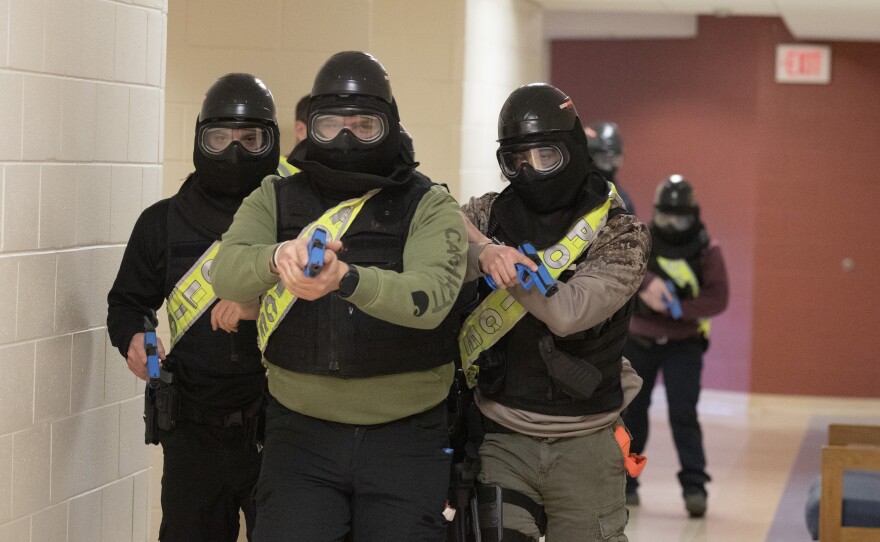


Inside the Bakeless Center, officers took turns playing the roles of victims, while others responded. They gathered information, made quick plans and coordinated the response.
In a place like Bloomsburg, officers from multiple departments would likely be the ones to respond to an emergency. The ALERRT training gives the officers tactics and techniques for how to respond.
“It allows all the officers participating to learn the same methodology of responding to the critical incident,” Neiderheiser said.