

Beneath a red, white and blue tent on the hallowed grounds of the Wyoming Monument, Christopher Pearl asked two questions.
"Whose ground, whose independence?”
“They are simple questions, but they lead us into a much deeper understanding of what happened here and what we mean when we commemorate independence,” he said.
Pearl, the chair of Lycoming College’s History Department, was the keynote speaker Saturday during the 148th annual commemorative service of the Battle and Massacre of Wyoming. The event on the monument's grounds also celebrated this year’s Fourth of July — America’s semiquincentennial and the anniversary of the beginning of the American experiment.
Pearl said July 4th carries enormous weight in American life.
"It is a day of celebration, certainly, but also one of reflection,” he said. “We gather to remember the moment when independence was declared, and we honor those who fought and sacrificed to secure it.”
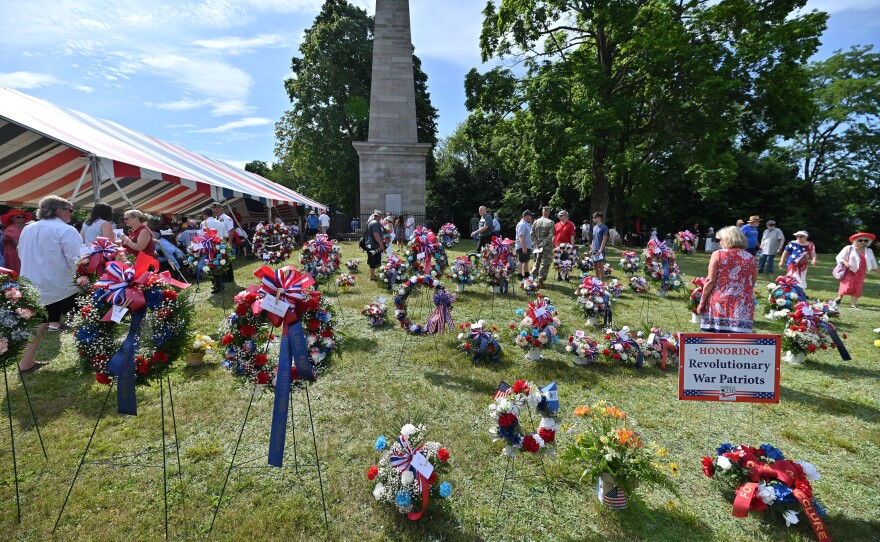
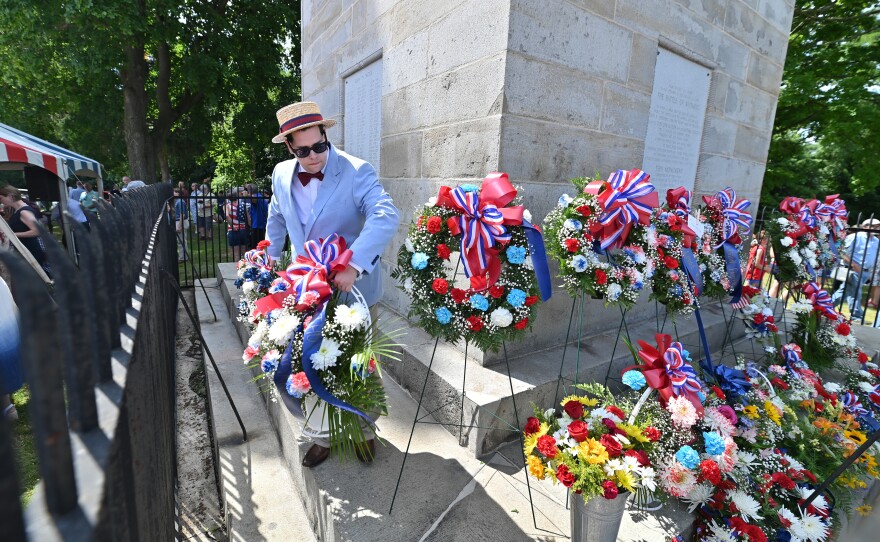
Pearl faced the Wyoming Monument. The large stone obelisk was built in 1833 and is a gravestone for many of the victims of the massacre on July 3, 1778.
The violent battle took place in what's now Luzerne County during the Revolutionary War, just two years after the Declaration of Independence was adopted. British-led loyalists and Iroquois allies battled with American settlers. During the fighting, 360 Americans, including civilians, were killed.
The battle also happened during a time when Connecticut and Pennsylvania were both warring, despite indigenous peoples’ homelands, over claims to land along the Susquehanna River.
A century after the battle, descendants of those who fought and the community began a yearly commemorative service.

Frank Conyngham is president of the Wyoming Commemorative Association, who organizes the annual event. He's one of the many descendents still involved in the preserving the monument and the battle's history today. Conyngham is a direct descendant of Colonel Zebulon Butler, who commanded the colonial forces during the battle.
He said the crowd at Saturday’s service was one of the largest, with one caveat.
“In 1878 there were 50,000,” he said and the crowd laughed.
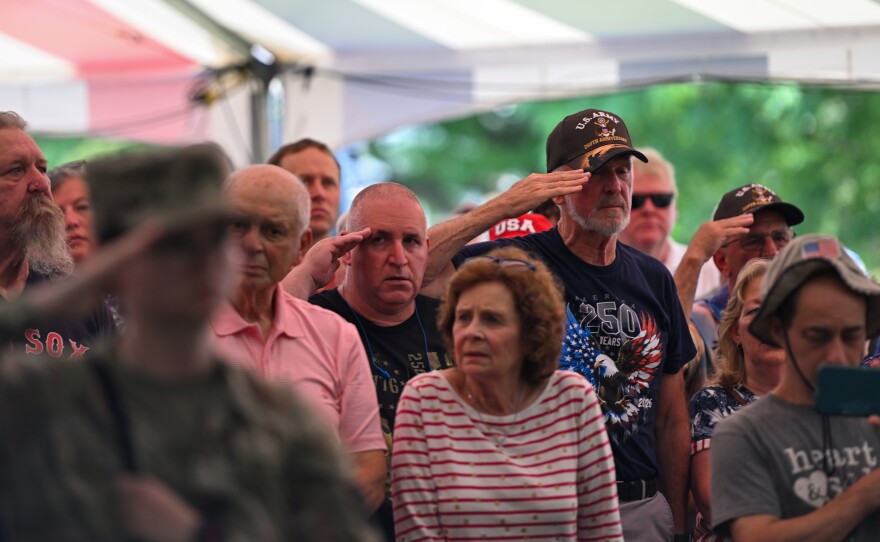
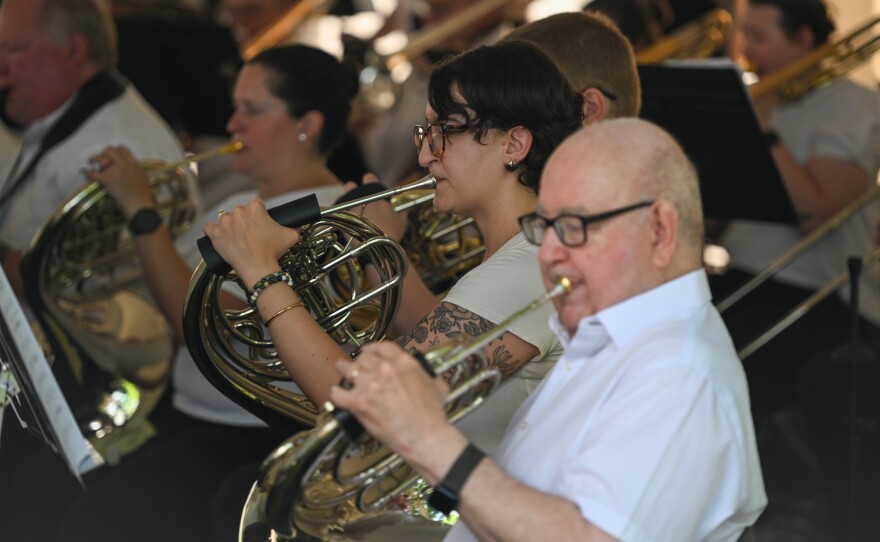
The Wyoming Valley Concert Band played patriotic music. Bandmaster Donald R. Williams asked active-duty military personnel and veterans to stand while the band played hymns from each branch of the military.
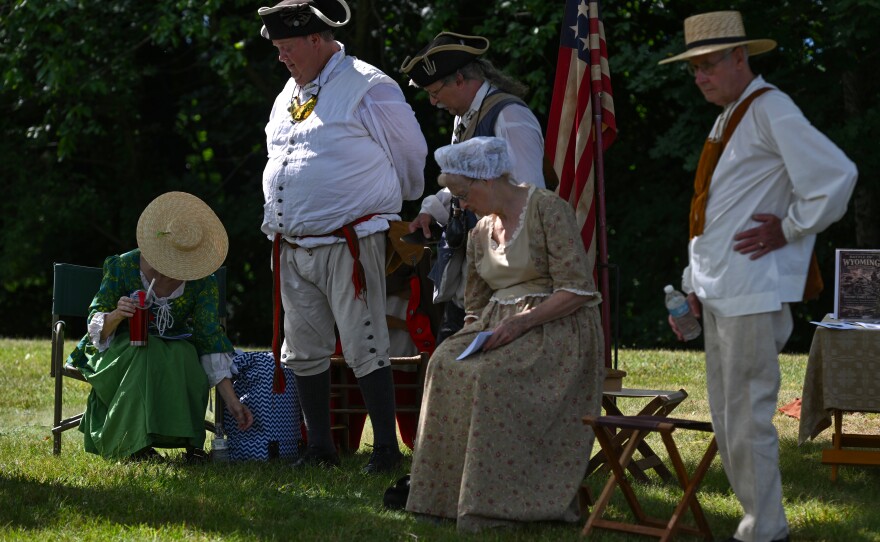
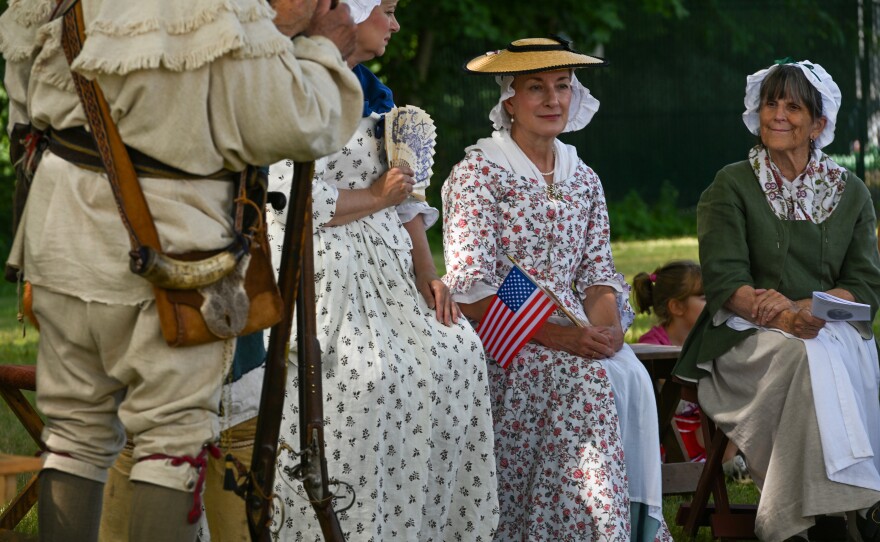
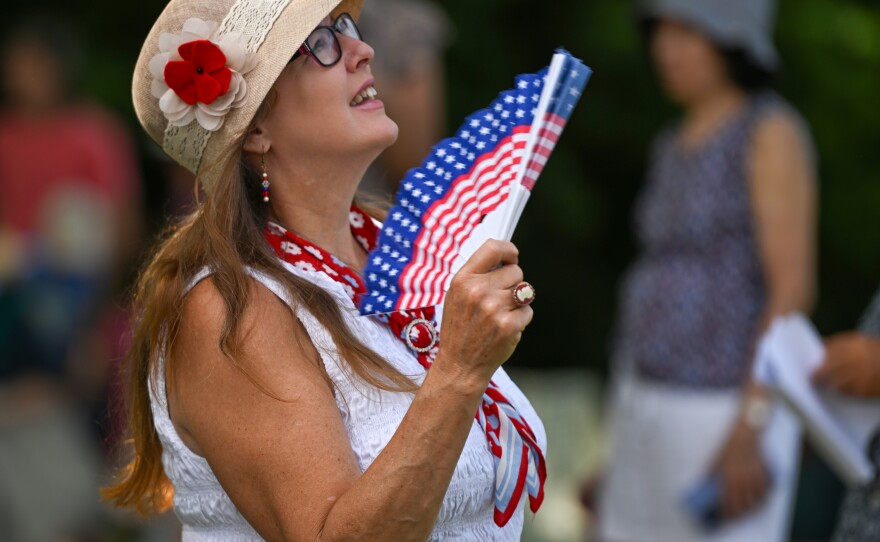
Members of the 24th Connecticut Militia Regiment reenactors contrasted with people in modern graphic Fourth of July T-shirts.
Members of the group, which preserves and reenacts the life and times of the common people of the Wyoming Valley, wore heavy gowns in floral prints reminiscent of the time, as well as buckskin pants, linen shirts with full sleeves and tri-corn hats.



Losses ‘echo for generations’

Pearl said ahead of 1776, communities in Pennsylvania pushed their state and federal representatives towards independence from the British.
"This area is really central in that way to achieving that goal, without these towns sort of coming together to ultimately debate and agree to independence, you do not have independence when you do, and you don't have the commonwealth," he said.
Pearl asked the crowd to imagine the landscape along Wyoming Avenue in Wyoming as it was in the 18th century, without monuments, roads or even today’s state lines.
"Instead, this is a river valley that connects worlds," he said.
He speech often mentioned the indigenous people who lived in the valley long before the European settlers, and how they fit into the revolution and the massacre’s history.
"This valley had long been a homeland, a meeting ground, and a diplomatic crossroads. Even after devastating wars and epidemics reshaped indigenous communities, native peoples did not disappear,” he said.
He said the battle in Wyoming was not simply between two clearly defined sides, but rather the product of overlapping conflicts.
"It was part of a war for independence from Britain, to be sure. It was part of a civil war among colonists with divided loyalties, and it was part of a broader struggle involving native nations navigating a rapidly changing political landscape,” he said. “The violence that unfolded here was devastating in result. Communities were torn apart, families suffered losses that would echo for generations.”
Independence a 'series of choices'
On America’s 250th birthday, Pearl reminded the crowd that the Declaration of Independence did not finish creating the nation, but rather declared the Founding Fathers' aspirations and announced a political vision.
He asked the crowd to again think about the mindset of those who lived in Wyoming on July 4, 1776.
"Would the British return? Would Pennsylvania or Connecticut prevail? Would native nations remain neutral, support the crown, or pursue their own interests? Would there even be a United States two years from then?” he said. “In other words, independence was not experienced as a single triumphant moment, it unfolded as a series of choices, risks, and sacrifices made under extraordinary violence and conditions, and its uncertainty.”
Pearl said that’s why places like the Wyoming Valley still matter so much.
"They remind us that the American Revolution was not won in Philadelphia with ink and parchment. It was lived in valleys like this one, where ordinary people experienced the revolution not as a philosophical debate, but as fear, loss, displacement and survival," he said.
Achieving independence, he said, was not clear or easy.
Independence today
Before he spoke, Pearl said there are still examples today of the founding principles of the United States.
He said the idea of a republic is that the needs of the community are greater than the needs of the individual.
Pearl pointed to neighbors in Luzerne County setting up cooling stations for those who lost power during Friday night’s storm.
"Americans will gather together to help each other, and I think that that's some of the things that I see as part and parcel of that sort of American experiment," he said.
Pearl’s research focuses on American history, especially the American Revolution.
He said Founding Father Thomas Jefferson would have been excited about the abundance of education for young people that exists now in the United States.
"I think that would have had resonance with someone like Jefferson, who believed in an educated citizenry, and because that's the only way the republic survives,” he said.
As for education, Pearl tells his students that historians return to the archives to understand old stories, like the Wyoming Massacre, more fully.
“Every generation asks new questions of the past,” he said, adding that they often find stories of those who were overlooked before.
“The revolution was never a single story, it was many stories unfolding at once in many ways. That is simply the human experience," he said.

