

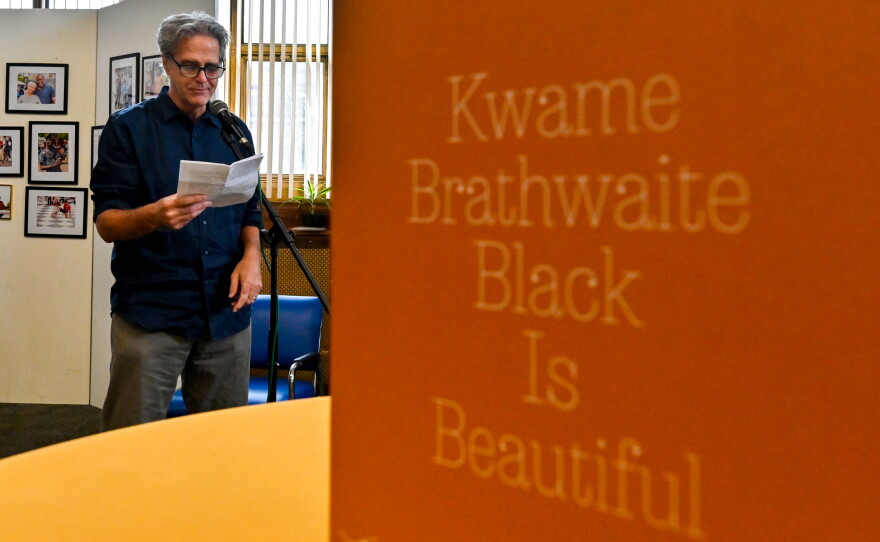
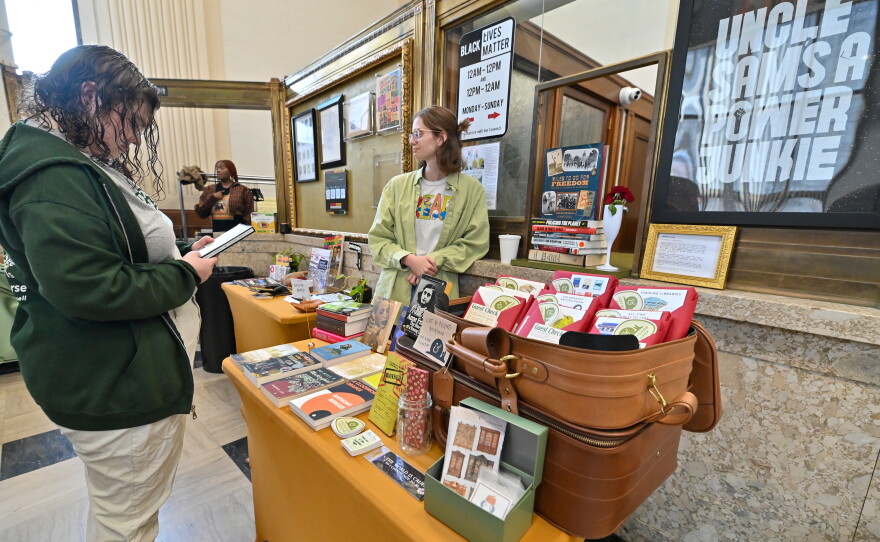
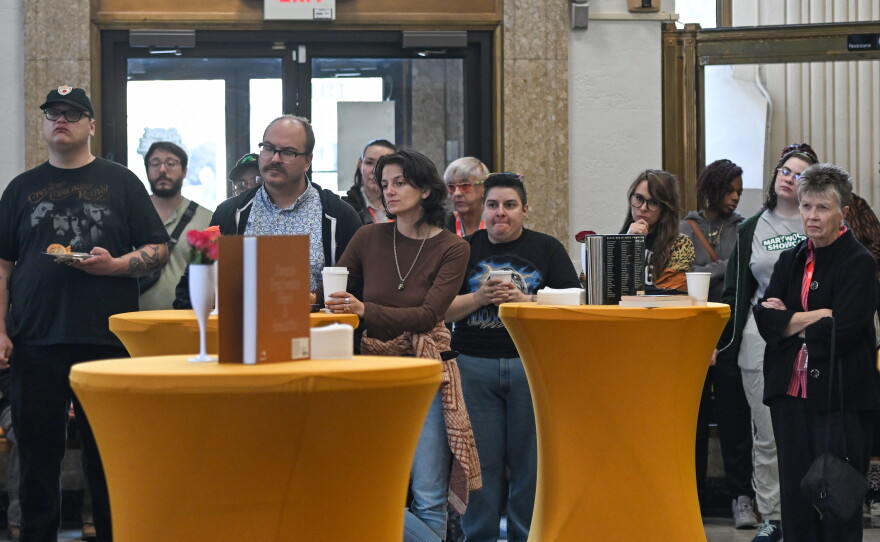
As the final day of the Scranton Fringe Festival dawned, book lovers gathered at the Black Scranton Project for readings that felt clandestine.
That’s because each person who stepped up to the mic during the Banned Books Brunch read from a book that has been either challenged or banned in the time since its publication.
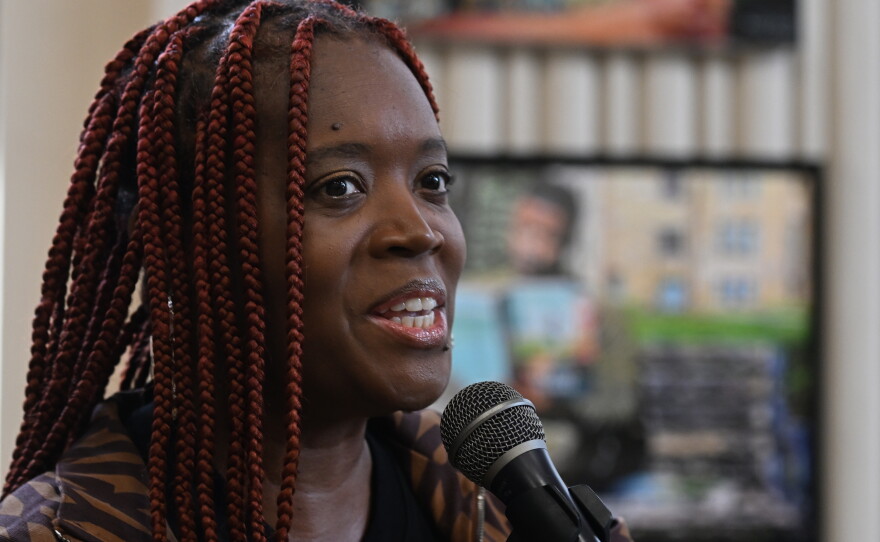
"A lot of times (a book) is banned because of other people's perspectives, or banned because of society's rules," said Glynis Johns, founder and CEO of the Black Scranton Project.
Johns hosted the Banned Books Brunch as part of this year’s Scranton Fringe Festival. She read from “Sula” by Toni Morrison.
"When a lot of these stories are stories that never really get to be told, I think that being able to share our stories, especially stories coming from Black authors, disadvantaged authors, really means something," she said.
Conor Kelly O’Brien is the executive director of Scranton Fringe. This year’s festival overlapped with the nationally recognized Banned Books week, so he said the brunch was a perfect fit.
"I think it's incredibly, not only silly, but harmful to be banning books," he said. "In this day and age, it's absolutely absurd."
According to data from the American Library Association, 4,235 titles were challenged or targeted for censorship in the U.S. in 2025, and that resulted in 5,668 books banned from libraries over the course of the year.
The ALA said this was both the highest number of titles censored in one year and the highest rate of challenges resulting in censorship from 1990–2025.
"I believe censorship of any kind, artistically in particular, especially when we're talking about putting books in the hands of children that expose them to real events, real narratives, true lived experiences is incredibly stupid to try to ban the book," O'Brien said. "What we consider controversial today, in 100 years, people are hopefully going to look back and laugh at why they ever considered that controversial."
The Banned Books Brunch opened the final day of what O’Brien says was the most successful Scranton Fringe Festival since the pandemic.
Banned Books Week and Scranton Fringe may be over, but to keep the spirit alive, we have some banned book recommendations this week.

Glynis Johns, founder and CEO, Black Scranton Project
Books: "Sula" and "The Hate U Give"
Authors: Toni Morrison, Angie Thomas
I just read a little bit of "Sula." I just kind of love the the 1920s, 1930s. My favorite era, and I love getting to read from like a black woman's perspective on life. So it's always a good, interesting read.
"The Hate U Give" is a classic good book. It's YA (and) a thick book, but it's a fast read.
I would say those two come to mind as books that I enjoy that are on that list. And now there's so many children's books too, which is crazy.


Conor Kelly O'Brien, executive director, Scranton Fringe Festival
Book: "I Know Why the Caged Bird Sings"
Author: Maya Angelou
When I was in high school, we read "I Know Why the Caged Bird Sings," and ... I know that's been challenged in different places.
Both its story and also its structure as a writer, was very inspiring to me. And so I would say, on the spot, that's probably the most important that comes to mind. But there's probably more.


Jess Ross-Steltz, "Bookstagrammer" bathtubbookworm
Book: "Slaughterhouse-Five, or The Children's Crusade: A Duty-Dance with Death"
Author: Kurt Vonnegut
My favorite book of all time just happens to be one of those banned books, which is "Slaughterhouse Five or The Children's Crusade: A Duty-Dance with Death" by Kurt Vonnegut Jr.
"Slaughterhouse Five" came out in 1969 and was a semi-autobiographical, science fiction-infused anti-war novel by Kurt Vonnegut, and I read it my senior year of high school.
I was absolutely enamored by the way this story truly defied genres and bent what I thought an anti-war novel could look like. If you haven't read the book, it follows Billy Pilgrim, who was in World War II and survived the bombing of Dresden. (He) becomes unstuck in time, and he starts experiencing his life out of chronological order.
There are laughs, there are moments of absolute dread, and also aliens. So, if this is a book that you haven't read yet, I highly, highly recommend it. It's super short; you'll bust it out in no time.
And if I can leave you with anything else, it's read banned books 365 days of the year and keep reading every single day.


Brigid Lawrence, owner, Friendly Alien Books
Book: "Looking for Alaska"
Author: John Green
John Green's award-winning debut young adult novel, "Looking for Alaska" follows Miles Halter, a teen obsessed with famous last words. He leaves for boarding school to seek what the dying poet François Roblet called the "great perhaps."
At Culver Creek, Miles meets Alaska Young, the clever, magnetic, self-destructive, and complex girl who pulls Miles into her world. Green captures all the messy feelings involved with growing up and finding yourself navigating the hierarchy of high school, first love, and first loss.
As Miles and his friends prank their rivals, readers can feel the angst and feel how real the stakes feel to our ragtag group of teens, and once the unthinkable happens, Green shows us how grief manifests in all of us, regardless of age.
"Looking for Alaska" is the first book that made me burst into tears, and I mean that in a good way. It was so important to me as a young reader, and while this remains one of the most challenged books in the country, I think readers of every age will resonate with the timeless themes Green brings to life in this novel.


Book: “The Giver”
Author: Lois Lowry
This week I learned one of my favorite books of all time is among the banned — “The Giver” by Lois Lowry. I know I’ve recommended this one before, but I was so surprised to learn it’s been challenged that I had to bring it up again.
“The Giver” is a dystopian tale of a society that has erased any difference between the people as a means of control. Only one person is able to remember or speak of the events of history before the Sameness. That is, until the elders name 12-year-old Jonas the next Receiver of Memory. He starts to learn from The Giver, who passes all of society’s memory on to him.
Lowry has taken firm stances against censorship as her book has been challenged over the years. I can’t imagine what my reading life would be like if I had never read this story.

That’s all for this edition of Bookmarks! Join us for another episode on Oct. 31.
