

To Stephen Colley, many military memorials feel polished and rigid.
Colley doesn't want his work for the Archbald Borough Veterans Monument Park to feel that way.
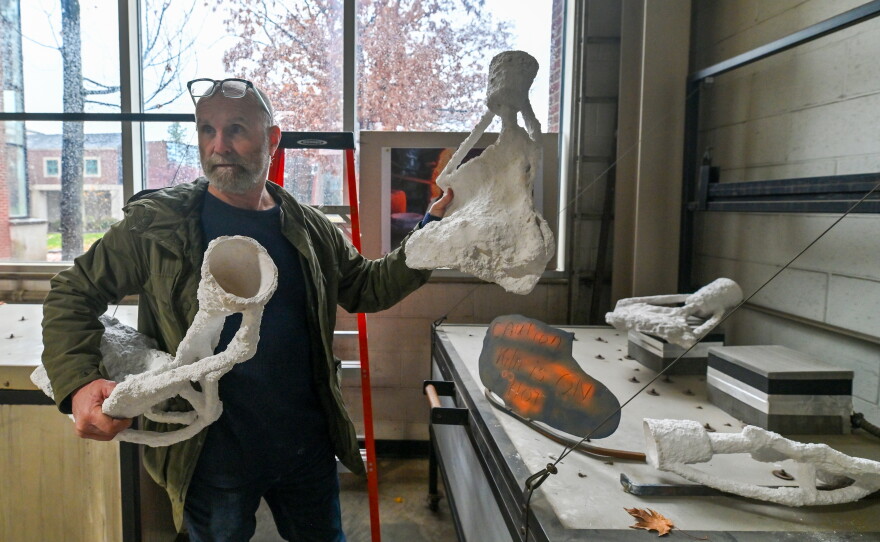
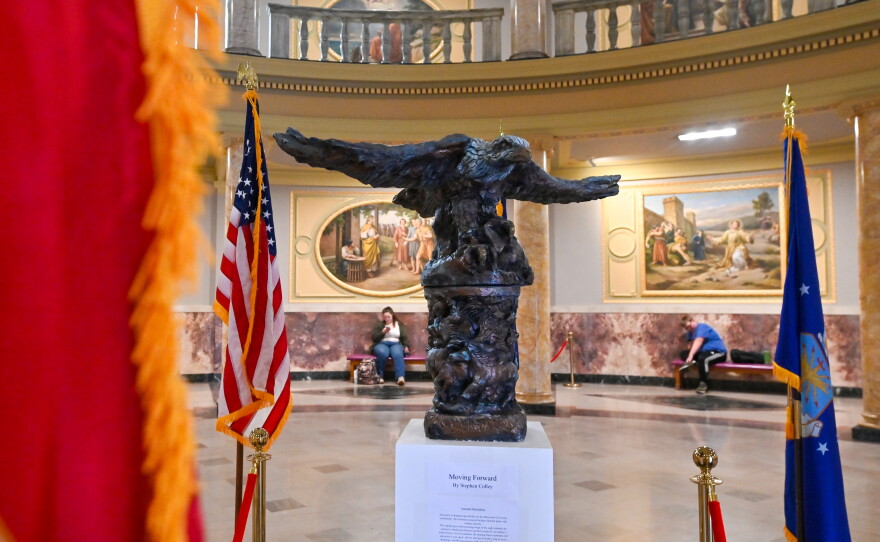
"It looks like movie stars were in the middle of war," the sculptor and Marywood University educator said of other statues he's seen as he stood over several miniature renditions of a 12-foot eagle obelisk he designed.
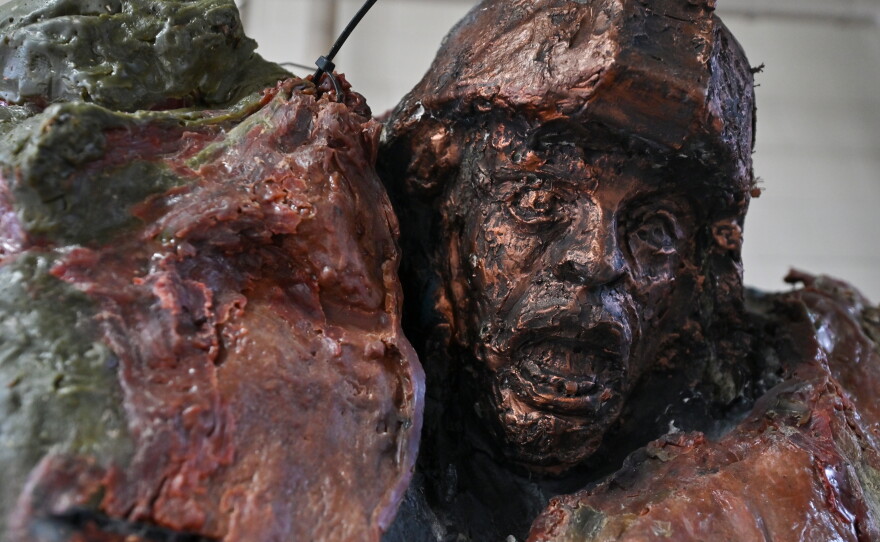
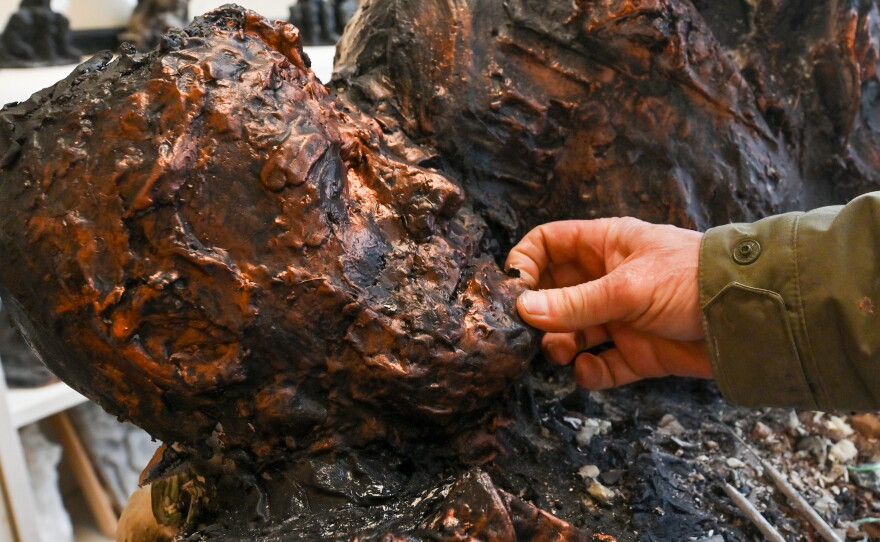
Rather than positioning the soldiers as polished and heroic, Colley’s bronze sculptures emphasize exhaustion and grief around military service.

Ten years, $1.5 million, and countless hours of volunteer effort have gone into building the park on Kennedy Drive. It's projected to be completed in Spring 2027, but the park is open to the public now.
The goal isn’t to glorify war but to show the raw and grim reality in an attempt to honor their sacrifices.
“Their glasses were crooked. Their hair was a mess. Their coat was ruined,” Colley said of the servicemen he's depicting.
“Some of these guys didn’t know what they were getting into,” he added with a sigh.
Behind the tall granite walls, military equipment and bronze sculptures tell a story that steps off the battleground into new territory — artistic expression, sacrifice and a determination to remind and remember.
Already, it's a place where visitors can reflect on the monuments to area residents who served their country.
“People don’t really know exactly the sacrifices they make,” said retired Army Maj. Robert Turlip, who has been involved with the project since its beginning.

'It’s time to get it finished'
A vision from 2016 is finally in a good financial position after years of fundraising and donation efforts. Turlip says the group received two grants this past year, which will finally give them that final push into completion.
According to Turlip, the project has been entirely supported through donations, grants and fundraising efforts rather than municipal taxpayer funding.
“All volunteers. We don’t take any money from the municipality. It’s all money that was fundraised, so there’s no taxpayer money involved,” Turlip explained in front of volunteers applying sealing tape to freshly hung tiles.
“We’ve raised all the money for it, and it’s time to get it finished,” he said.
But that doesn't mean there may not be more fundraising to do.
“We’ll probably do a couple other fundraisers,” he said. “I think the major part of the work to be done for the park will have enough money to complete. We can add on as we go.”
Between the pandemic, the need for a $350,000 stormwater system, and several key committee members passing away, the project has had to overcome some hurdles.
One of the largest obstacles was that stormwater management system.
Jerry Munley, a committee member, explained his experience at a meeting where a local expressed frustration with the park’s delay.
“You drive by, what do you see? Nothing. Well, I see $350,000 underground,” he explained.
The project also required finding a suitable location.
Turlip said the committee spent almost two years looking for a suitable location before Lockheed Martin donated 2.4 acres of land.
Turlip said they are focused on installing their parking lot and monument walls. These monument walls include veterans’ tiles that families can purchase where a picture and sentiment about what their time in the service was like.
He said the committee is halfway through installing over 200 granite etched tiles they have sold, but they have space for 500 in total.
Volunteers worked together to install the engraved tiles, carefully measuring seven in a row, applying adhesive and preparing the seams to prevent damage from winter weather.
Some tiles have been waiting for installation since 2022 and are being hung up before temperatures drop for the season.

Bringing a vision to life
Colley is working on some of the elements of the park, designed to tell an interactive story of honor and healing.
Among the elements is a kneeling soldier with a military dog, both processing the loss of another service member. An eagle positioned atop a 12-foot obelisk overlooks the interactive art scene.
His current focus among ongoing projects is on a nurse holding a wounded soldier who is in his final moments. While the sculpture is still in its early stages, Colley is carefully developing the expressions to convey the grief that military personnel face.
His end goal is conveying the unspoken communication that takes place between military nurses and the wounded — mutual pain, but also efforts to bring comfort in those final moments.
He aims to have the sculpture finished by this time next year. It will be positioned in front of a not-yet-tiled wall.
“Steve added that added touch with the statues,” Turlip said. “Just being able to have him bring some of our statues, our thoughts to life … it has really been a benefit for the project.”
The sculptures are only one element of the park’s broader representation of military service. The committee has acquired artifacts including a tank and other military equipment, as well as plaques for individual veterans, and there have been discussions about seeking a helicopter.
Turlip explained that the goal was to represent different experiences and branches of military service rather than focus on one element.


'Each of these people has a family'
Turlip is among more than a dozen contributors to the park project. Some have family trees full of veterans, others have loved ones on active deployment.
“We have a core group of about fifteen people that have really done a great job over the years doing this project,” he said.
That group was once much larger in numbers. According to Turlip, approximately 30 people were involved in the project at different points throughout its different development stages. Some stepped away, while others died before seeing the park completed.
During a recent park visit, veteran and committee member Michael Goyne reflected on the uncertainty that military families face while their loved ones are deployed.
He recalled being stationed in Iraq and making several calls to his wife after dangerous incidents to reassure her of his safety.
“Each of these people has a family and a community, and family … they’re the ones that worry about you,” he said.
Goyne and his wife can now enjoy retirement and vacation together, but it wasn't always that way.
“As a reservist, you miss vacations, holidays, birthdays … because you can’t say no,” he said.
Colley also has personal ties that inform his work. He grew up on Navy bases and experienced military family life.
“I feel like I can explain my pain as well as other people’s pain through this medium,” he said.
For veterans, their families and other park visitors, Colley hopes the sculptures offer more than a visual tribute to their sacrifice. He aims to provide a space for healing and meditation.


'It's for all our veterans'
Turlip’s family has done their part in serving, according to him. “We think it’s very important we do this, and it goes along with what our [family’s] values are.”
“My son is deployed, but he’s not the only one,” he says. “My soldiers, Air Force airmen, and sailors alike, on long deployments now, we keep them in our thoughts and prayers.”
Turlip emphasizes that the park is not an exclusive experience for those who purchase tiles.
“It’s not only for them. It’s for all our veterans,” he said. “We have our veteran wall from World War I all the way up to current."
Each engraved tile includes details from their time served, photographs and military insignias that offer visitors a glimpse into the story behind the plaque.
After a decade of fundraising, construction setbacks and grief, the committee is reaching the finish line of a deeply personal project.
“It was very costly. But it’s going to be really beautiful when it’s all finished,” Turlip says.
On Nov. 9, committee members and volunteers gathered for a photograph in front of a memorial where they hung the final tile.

Community involvement
The committee grew from collaboration with local veteran organizations, including American Legion posts and Veterans of Foreign Wars posts.
Other organizations collaborated with one another for the project, like Camp Freedom and Boy Scouts, who have refurbished military equipment for the park.
Physically moving the sculptures requires a whole new element of organization and community effort.
The latest installation from Colley, “Kneeling soldier with his dog,” weighs 12,000 pounds.
Even the lighter artwork requires precision. The tiles are systematically checked by volunteers to fact-check and ensure there are no distributor errors. The committee also coordinates with families to determine where the plaque should be placed, particularly friends and families that request loved ones to be positioned side-by-side.
“Then we called everybody and asked, ‘Where do you want it?’” Goyne said, recalling a situation where cousins wanted to be placed next to one another, and he had to find the duo in dozens of stacked tiles.
The installation system has become routine for the committee.
“Same time tomorrow, Rob?” Sabia said as he pulled his car keys out of his pocket.
The volunteers have been meeting multiple times a week to quickly hang the remaining tiles before the cold weather presents challenges.
Though the park is designed to recognize military service, Turlip hopes the space will also appeal to residents without a direct connection to the armed forces. He discussed the possibility of community gatherings and memorial parades.
“I think as they [the community] see everything coming together, the community is really happy about it,” Turlip said.
Passing skills to the next generation
Colley has been an on-and-off art teacher for about 40 years, he said. He believes extending the opportunity for students to witness the creation of large-scale bronze artwork could inspire and motivate them in the field.
While students can’t directly pour bronze due to safety concerns with the extreme temperatures, they assist in preparations, cleaning cast pieces and other stages of the creation process.
“The whole point was to teach them this process,” he said. “You can make a living doing this.”
He hopes this encourages students to have the confidence to pursue their work in the professional art world, despite the conversations surrounding financial stability in more creative careers.
“It’s not about money,” he said.
While Colley aims to teach the next generation artistic creative expression, the committee aims to teach the history of silent heroes.
The committee also sees the project as an opportunity to educate the next generation about the realities of military service.
During the installation of the tiles, Goyne explained the meaning and significance of military medals and service insignias, which are all on the tiles to represent the full picture of the servicepeople they commemorate.
Joe Sabia, another volunteer and veteran, expressed concern that the younger generations have fewer opportunities to learn about service people. He hopes this bridges that gap.
“One thing we don’t do is we don’t celebrate heroes anymore,” he said while checking the evenness of a freshly applied tile.

'I want these sculptures to be forever'
Colley joined the project about halfway through its process, but he’s far from retirement.
He hopes to eventually create a 17-foot-tall Gold Star sculpture to honor families who have lost loved ones to military service.
Colley said he previously discussed the idea with Gov. Tom Wolf, but the pandemic interrupted its progress. He hopes to revive the proposal when the time is right.
His goals are ambitious. He says he wants to complete at least 50 major sculptures.
However, he doesn’t equate the number of completed works as a measure of success.
“I want these sculptures to be forever,” Colley said.
For Colley, the purpose of a memorial is not to be a showstopper but a tool to generate feeling.
He talks about catastrophic events and how they can destroy art, but these sculptures can live forever to pay homage to these sacrifices.
While the bronze-covered sculptures promise longevity in their structure, so do the granite-etched plaques placed with a diligent and precise system for hanging.
When asked what they’ll do when the project is finally completed, Munley said with a laugh and big smile: “You’re going to see tears of joy coming down.”