

Tannis Kowalchuk took the melody from a song performed in traditional Scottish mouth music and added modern-day words.
“We walk. We sing. We shout. No more kings,” she sang to lead a crowd gathered at Fred R. Miller Pavilion on Main Street in Honesdale. “No more kings, no more kings, no more kings.”
“It’s a nonsensical song,” she said of the original. “They had mouth music because they were not allowed to sing in their language because the [British] monarch was oppressing them. So I'm using that song as a protest song against the notion that we are living in a growing tyranny here.”
Mouth music — or puirt à beul — can often be traced back to when the British were said to have banned bagpipes and Gaelic in the Scottish Highlands.
Kowalchuk helped form Singing Resistance NEPA this year. The group led a crowd of around 300 people in a march through the Wayne County borough to mark the third "No Kings National Day of Nonviolent Action." Events were held throughout Northeast Pennsylvania in places like Scranton, Wilkes-Barre, Jim Thorpe and Tunkhannock.
“The Trump administration's harmful and reckless decisions continue to impact every individual and family nationwide, but this Saturday, millions of voices are showing up to send a powerful message: No ICE. No Illegal Wars. No Kings,” according to the official organization.
The first "No Kings Day" rallies were held on June 14; a second was on Oct. 18.
“‘No Kings’ is more than just a slogan; it is the foundation our nation was built upon. Born in the streets, shouted by millions, carried on posters and chants, it echoes from city blocks to rural town squares, uniting people across this country to fight dictatorship together,” according to NoKings.org.

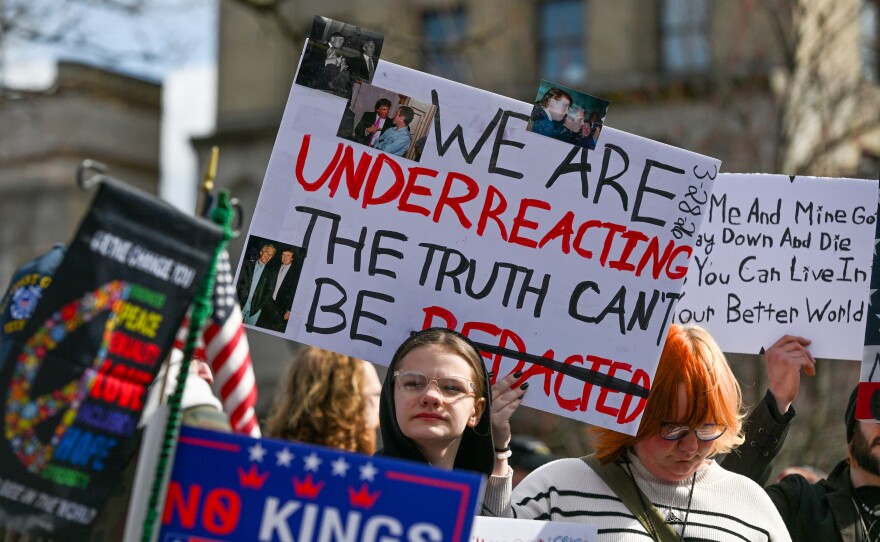


Resistance through music in Honesdale
A Singing Resistance movement began days after Jan. 7 when Renee Good was shot and killed by Immigration and Customs Enforcement (ICE) agent Jonathan Ross in Minneapolis. That movement has since spread throughout the country, including Northeast Pennsylvania.
Singing Resistance NEPA started in late February. They met up to sing protest songs and uplifting music, Kowalchuk said.
"Unity and democracy and humanity are something that I feel is like, just really starting to get drained from our country's consciousness. So that's what I'm singing for,” she said. "Singing brings people together, and singing asks us to come together and celebrate positivity and goodness, but also question what's wrong as well."
She said a woman from Schuylkill County, about 97 miles away from Honesdale, comes to sing and bring the music back to her community.
"The amount of folks that are showing up, it's really, really inspiring to me, and it makes me see people need this. We need to be together, and we need to speak to the things that are really disturbing us right now, disturbing us about policy, about a government, about what's going on with war,” she said.
Kowalchik stood on a picnic table and taught the group her No Kings song before they marched through Honesdale. They also sang Pete Seeger’s “Step by Step” and Buffalo Springfield’s “For What It’s Worth.”
Once they got back to the pavilion, they sang patriotic songs and "Our Song Is Stronger Than The Fear" by Minneapolis-based songleader and musician Sarina Partridge.
The group meets on Mondays at 6 p.m. at Greenhouse Cafe in Honesdale. The choir now features around 30 to 50 singers from all over Northeast Pennsylvania.

Revolutionary music
A guitarist and drummers provided the beat for the resistance singers. At the top of the march, however, a fife and drum corps led the procession.
Pamela Arnold played the drum. Richard Fairbanks played the fife, a small six-hole flute. They both wore bright yellow “Don’t Tread on Me” T-shirts and tricorn hats.
“A lot of what we've chosen to play today goes back to pre-revolutionary times, and many of the songs that we played going down the street go back to what they would be playing in 1776 when we were getting angry with some other folks in the world,” Fairbanks said.
Arnold said the phrase “Don’t Tread on Me” has been co-opted recently.
“But originally this was the 13 colonies telling the King of England 'don't tread on me'. So since this is No Kings, that's why we're wearing these shirts and playing the revolutionary songs from 1776,” she said.
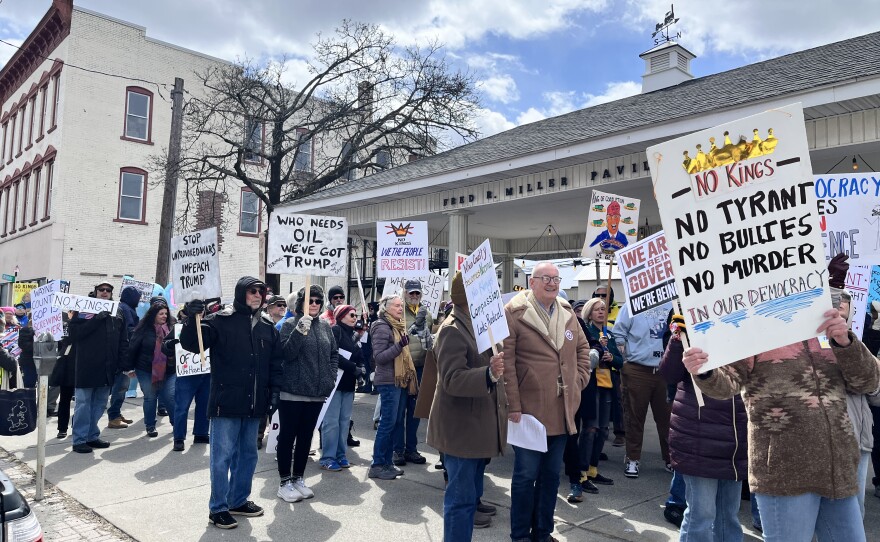
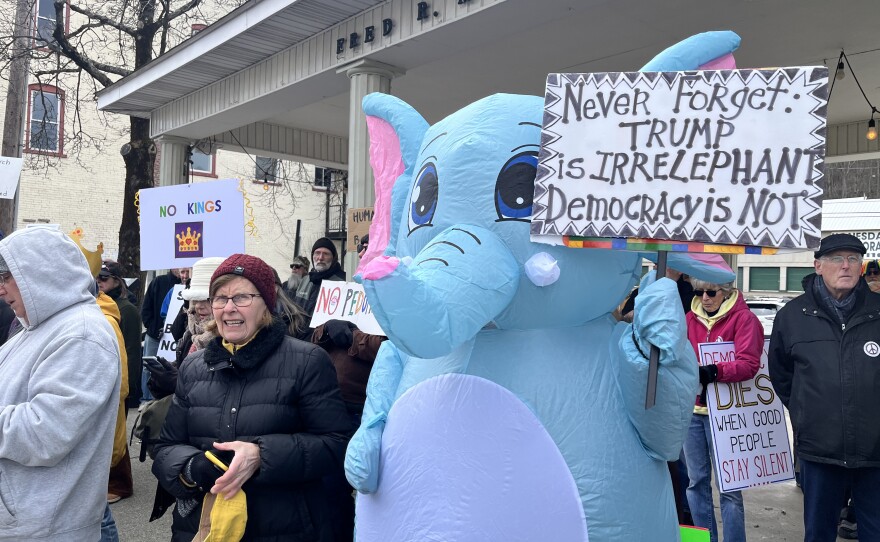
'There are hundreds of us out here thinking things are crazy'
Kelsey Franjione said she held a rectangular cardboard sign to let everyone know she was at the event for free and willingly.

“Anytime we do a No Kings protest, I see everyone on Facebook say that everyone was bused in, that we were all paid to be here, that we must not live here,” she said.
Franjione lives in Lake Ariel.
“I come here every time and see the person who serves me bagels and the people who teach at the school and my neighbors from down the street,” she said. “I just want everyone to know that I live here and I care about our community, and that is why I am here.”
She’s 34.
“Things have become so crazy recently. It's scary on a day-to-day basis, with all the changes that are happening,” she said. “Everything is going in a negative direction, where gas prices are higher, grocery prices are higher, and we're at war now, which is scary.”
But she said seeing those cafe workers, teachers and neighbors is energizing.
"It makes me feel like change is actually happening and it's on the horizon, because there's not just four of us out here thinking things are crazy. There are hundreds of us out here thinking things are crazy. So it warms my heart to know I'm not the only one who feels this way.”

Comparisons to past wars
Carol Lawson said she held a sign she used to protest the 2003 Invasion of Iraq.
"I want to support my community, create as much awareness as I can, and to feel the sense of community … not to be alone with the upset, the terror, the fear, the anxiety,” she said. “To do something for this generation coming up and all the other generations.”
The front of Lawson’s painted sign pictured a Muslim woman holding a dying child. On the back, an American soldier was pictured holding a bleeding soldier.
She fears the current War in Iran will turn into the Iraq War, which lasted from 2003 to 2011.
“We don't know what's going to come out of this exactly; they don't seem to have a plan,” she said of the Trump administration.
Arnold said he also sees similarities between today and a war of the past, the American Revolutionary War, when the United States gained independence from the British Empire.
"It seems to me that our current president is celebrating the 250th anniversary of our revolution by recreating the conditions we fled 250 years ago, which is not the proper way to do it,” Arnold said.
Fairbanks and Arnold participated in No Kings Day in June. Saturday felt more energized, Fairbanks said.
“We felt good then, we knew we were doing right then,” he said. “We feel more right today.”
