State Rep. Bridget Kosierowski underwent surgery for her ductal carcinoma in situ, a type of breast cancer, about three weeks ago.
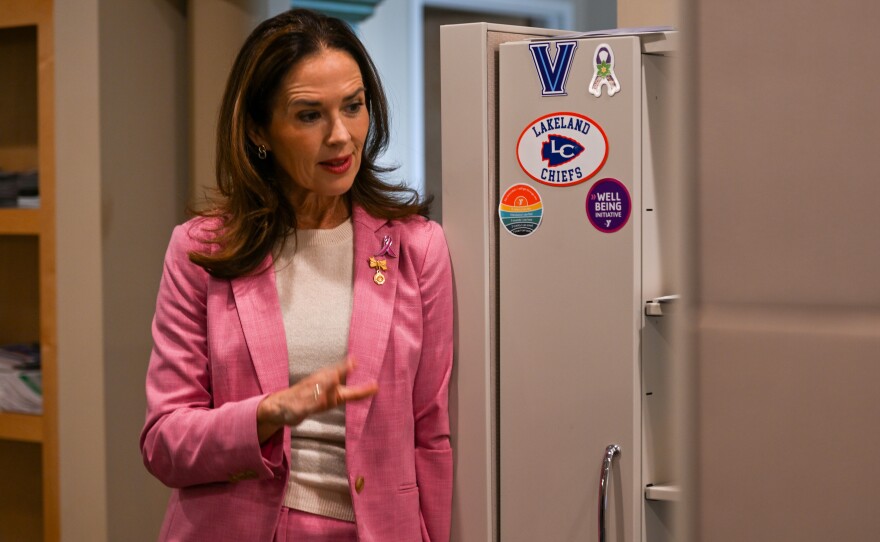
But with a confident walk and a pink pantsuit, complete with baby pink block heels and a breast cancer awareness pin above her state representative pin, it’s hard to tell.
She mingled with her staff, telling stories and cracking jokes in her Dickson City district office.
“As soon as I was able to know what kind of cancer I have and that there is a treatment for it, the five- and 10-year statistics are pretty decent," Kosierowski said of the disease's survival rates.
"That gives me an enormous amount of hope,” she said with a smile.
The Democrat from Lackawanna County, who represents the state’s 114th House District, announced her diagnosis on June 23.
“When I released my video on Facebook to make my announcement, by the time that aired, I was already in the operating room. I was under anesthesia,” she said.
Now recovering from surgery and awaiting a treatment plan from her medical oncologists, she expressed optimism about her prognosis and a desire to help others catch cancer early.

Kosierowski’s health update
Kosierowski received her breast cancer diagnosis on May 20.
Ductal carcinoma in situ is a very early form of breast cancer and is sometimes called stage 0 breast cancer, according to the Mayo Clinic.
“It's a very common diagnosis, and it's one that we know how to treat. My prognosis is good, but there are times when people have this, and then they do not get the screening done. They can't necessarily feel it, or they have no symptoms," Kosierowski said. "And then not having that diagnosed earlier, sometimes it does become invasive, and it becomes harder to treat.”
According to the National Cancer Institute, Pennsylvania’s incidence rate of this type of breast cancer is 31.6 per 100,000 individuals. The average annual count is 2,625 cases based on data from 2018 to 2022.
'I feel really good. I would not push myself if I did not feel good or I had any complications.'
— State Rep. Bridget Kosierowski on returning to work amid cancer treatment
The state representative wants her constituents to know she is doing well and slowly returning to work.
“We women, especially working women and working mothers and nurses, are a dangerous combination because I don't think we sit down in our daily lives, so it's hard to rest,” Kosierowski said. “Being a mother and a nurse is a combination that is a fierce one. They're advocates for their patients. They're advocates for their family. But I think you have to sometimes take a deep breath and advocate for yourself for a little bit.”
She said she is happy to be back to work.
“I feel really good. I would not push myself if I did not feel good or I had any complications," she said. "So far, so good. I feel good."
Previous to her career as a state legislator, Kosierowski worked as a registered nurse.
“Keep in mind, I'm a nurse, which is good and bad,” she laughed.
She said her passion for her job made it easier to work through her diagnosis and after her surgery.
“I've always tried to take care of people as a nurse, and I get to do that now as a state rep. So I think that that's been a blessing that I actually do enjoy my my work,” Kosierowski said.
Constituents, colleagues and followers flooded her inbox after she announced her diagnosis.
“There were hundreds of women that emailed me, texted me, Facebook messaged me, saying, 'Hey, thank you. I never had a mammogram, and now that I listened to your story, I'm going to go get one,'” Kosierowski said.
And in Harrisburg, her colleagues have been nothing but supportive.
“They’ve just been very supportive of me because that's my own little family in Harrisburg now, believe me, it's bipartisan. Cancer doesn't care if you're blue or you're red, or you're a liberal, or you're a conservative. It doesn't care. It could care less. It's cancer, and it's coming. To have a system of friends like that is, I'm really lucky, and I'm grateful, and I'm blessed that I have that kind of support system,” she said.
The positivity reminded her of the privilege of her role in the state legislature.
“There are so many people that reached out to me, told me their stories about cancer, told me that they went ahead and got the screening done because I reminded them how important it is. That's the platform that I am blessed to be able to stand on because of being voted into the House of Representatives by my community,” she said.


An advocate for preventive care and clinical trials
The National Breast Cancer Foundation found that 1 in 8 women in the United States with breast cancer in their lifetime. For men, it’s a much lower risk of 1 in 755. The Foundation estimates that about 382,640 women in the United States will be diagnosed with breast cancer this year.
But, the Foundation estimates that the five year survival rate for early-stage breast cancer diagnosed at the localized stage is 99%.
Doctors caught Kosierowski’s cancer early after a routine mammogram screening.
“It could change people's lives because that screening that I went and got, it did change the trajectory of my outcome,” she said.
Kosierowski wants others to take away from her experience the importance of regular screenings.

“There's only really five [cancers] that we can screen for. There's breast, there's colon, there's cervical, there's lung, and there's prostate. The ones that we can screen for, we can get it early, there is a much better outcome,” she said.
She now awaits a treatment plan, that could include chemotherapy or radiation, from her medical team. Regardless of what they decide, she expressed her gratitude for those who came before her and participated in clinical trials.
“I don't know why I have this, but I do have it. But I'm grateful that we have a treatment,” she said.
Her son endured a four-year cancer battle at just four years old.
“I always remind people that I have a little boy who's now 25, my son Jake, at age four, was diagnosed with leukemia. Because of the kind of leukemia he had, when he was diagnosed at age four, he is now in remission. There was lots of research done on children that had leukemia,” she said.
“Jacob did that when he was a little boy. I signed consents for them to use his cerebrospinal fluid samples to use in clinical trials to say, hey, this kid has this kind of leukemia. These are his counts. This is what we're doing,” Kosierowski continued.
Kosierowski said her family's experiences with clinical trials will make her continue to advocate for their funding.
“I can't emphasize enough how important research is, and I am a politician, so I'm going to remind people that upon us as policymakers [to secure] funding and making sure people understand the truth … about what actually research is, what clinical trials do, and what medicine is, and what physicians do," she said.
A champion for accessible health care
Kosierowski emerged as a leader in the fight to find a new buyer for three area hospitals that were at risk of closure until this year. Accessible health care and specialized care drove her during that process.
She knows the favorable outlook for her cancer battle is helped by her life circumstances, including how accessible care is to her.
“It does not fall short to my knowledge that I have really good insurance. I am a nurse. I have resources. I have support, and I have advocates. Not only I can advocate for myself, but I have family and friends and people that I can call upon to say, ‘Hey, who's the best surgeon? Where do I go? Who treats this? How do I get there?' All those kinds of things that are barriers for a lot of people,” Kosierowski said.
She said her cancer diagnosis and treatment make her even more inclined to advocate for accessible health care in Harrisburg.
“What I have been laser focused on for the last six years of my life in my job is access to care, affordability and information, because there's no reason that two 54-year-old women sitting here should not be able to have the same access to care, the same pathway and the same outcome,” she said.
Kosierowski co-sponsored a bill this session that would require private insurance to cover preventive services like screenings, vaccines and medications. The bill has been referred to the insurance committee. She wants anyone concerned about their health or seeking a cancer screening to be able to get one.
“The insurance company should absolutely in no way have anything to say whether or not they should have it done. That drives me absolutely bonkers. And insurance companies have to understand that screening saves money in the long run,” she said.
She also sponsored legislation introduced in April that would require insurance to cover certain fertility preservation services for cancer patients whose treatment may result in infertility.
Kosierowski said she also plans to collaborate on other early screening legislation with state Rep. Jordan Harris (D-Philadelphia), who lost his wife to colon cancer.
“I am the example of what I was working on, and I have a good outcome, and so I'm hoping I still have a good story in five years and in 10 years. I was already working on some things that directly affect me as a patient. So now I'm the patient. So now I even have more reason and more knowledge and more empathy and compassion to do it even more,” Kosierowski said.