

Tina Verrastro and Mike Sowden moved into his parents’ Archbald home in 2019. Their son began in the Valley View School District as they made the home their own.
"We're nature people. Like our backyard, it's beautiful. Totally private. It's we're like two minutes from town, but it's like we're in the country when you go on our deck,” Verrastro said.
The poster boards on easels that wrapped around the third floor gym of the Archbald Borough Building did not bring them comfort about their new proposed neighbor — the seven-building Project Gravity Data Center campus.
"It's wildly inappropriate. All of these blown-up pictures of seeing how close everybody's houses are. We're not the only ones that are close. It's disgusting,” she said.
Corscale, the developer for the data center campus, held an open house with food and refreshments for the greater Archbald community. Experts working on the data center campus stood among the boards to answer questions from residents, many in signature yellow Stop Archbald Data Centers and Archbald Residents for Responsible Zoning t-shirts, about Project Gravity.
The campus is one of six data center campuses proposed for the borough.

"I think they're trying to make nice with us now because they know how opposed the public is to this project, and I don't think it's going to work. I don't think anyone's going to leave here feeling any better,” Verrastro said.
Erik Draaisma, executive vice president of business development for Corscale, said the open house is part of the company’s normal process.
"It's not unusual, the type of questions that we're getting. What I think is unusual here is there are some very strong preconceived notions about data centers in general and the project, and the task at hand for us is to address those in a gentle and transparent way, to try and explain to people what we're doing,” he said.
The company submitted final land development plans to the borough last month.
Corscale is the only one of the five developers in Archbald to hold an open house, or make company leaders, other than lawyers, available to answer the public’s questions on a data center campus project.
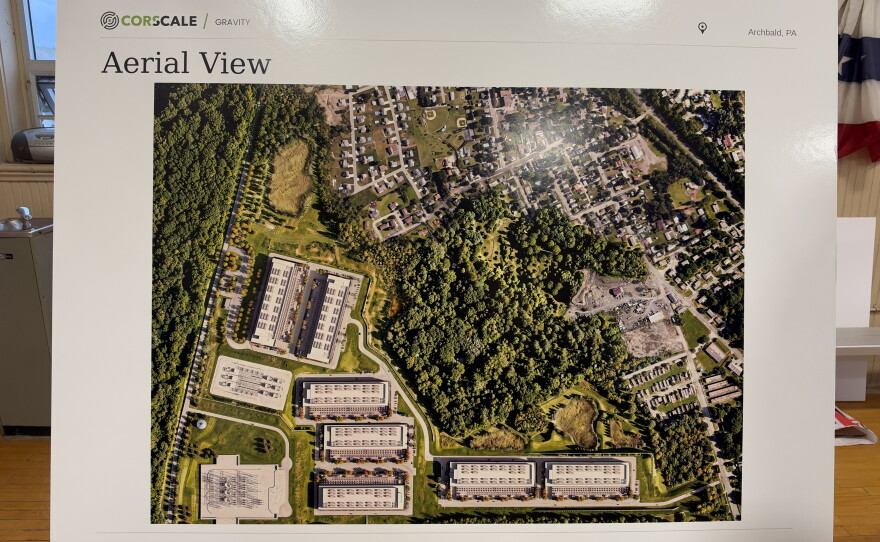
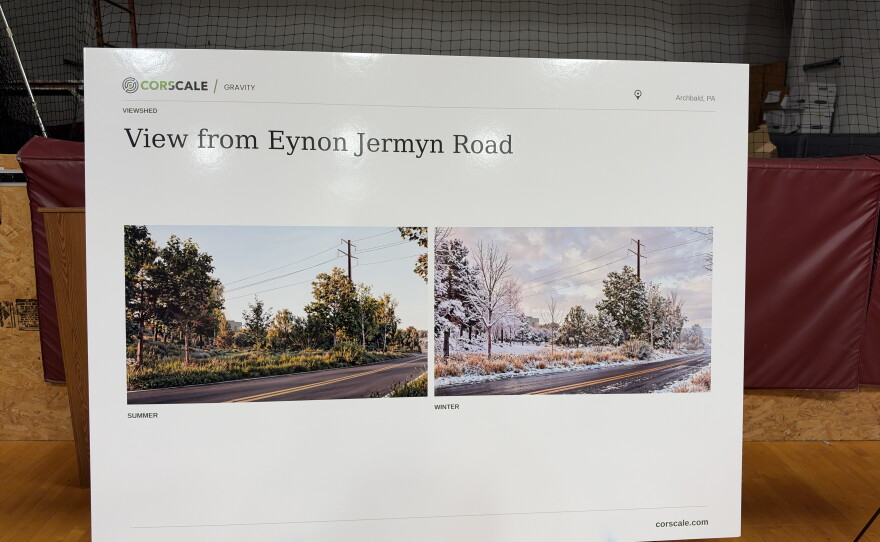
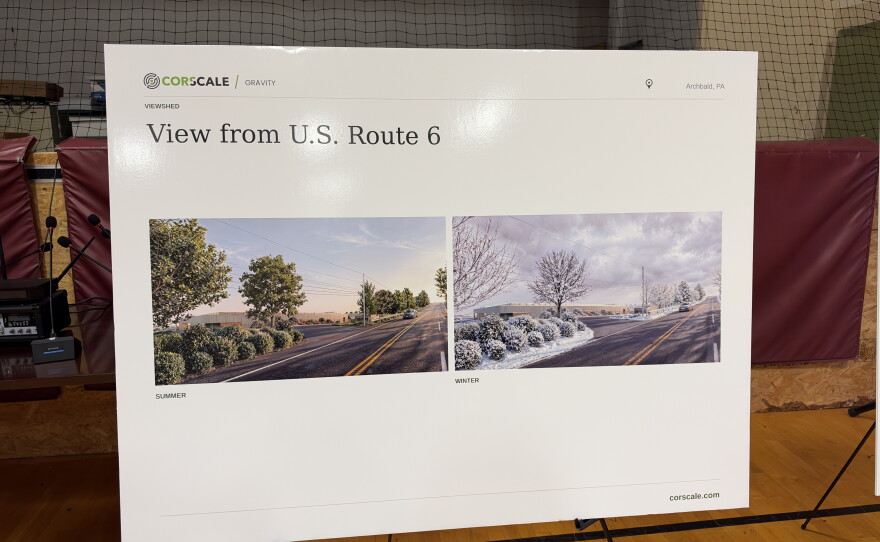
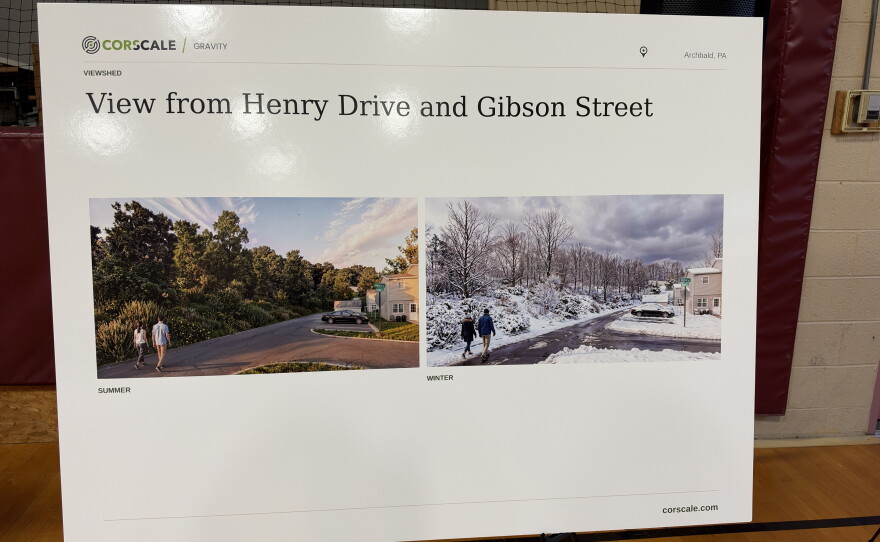
Facts and renderings
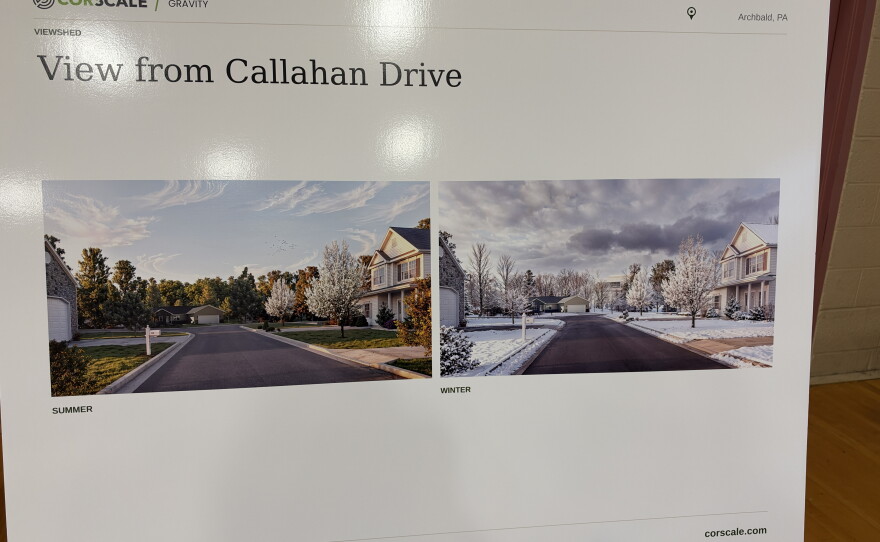
The posters provided insight into the project’s economics and included renderings of what the buildings could look like to neighbors.
Still, many Archbald residents left the borough with the same skepticism they arrived with.
The campus would be most visible from Business Route 6, according to the renderings. From the neighborhoods it borders, buildings slightly peek out from behind trees.
Other information from the boards included:
- Active mining on the site ended in 1955. Corscale plans to revegetate or restore 25 to 25% of the property.
- Corscale will negotiate a voluntary community benefits agreement with Archbald, in addition to the taxes created by the project. The agreement will invest in public safety and infrastructure, workforce and education, downtown and the community and municipal readiness support.
- At full build-out, Project Gravity is expected to generate $20 million a year in tax revenue, of which 60% will benefit the Valley View School District.
- The company has not requested any tax abatements.
- The campus will create 300 to 325 full-time jobs and more than 1,000 construction jobs.
- Corscale plans to invest $8.4 billion into the campus.
- Instead of using diesel-power generators as a source of backup power, Corscale plans to use a 430-megawatt battery energy storage system, or BESS.
- The campus will still use 45 generators in total, a reduction from 260 without the battery system.
- Project Gravity will use a closed-loop cooling system, which recycles fluid to cool chips. The expected daily water usage is 7,500 gallons.
- Wastewater will be an ordinary domestic flow, not an industrial discharge.
- Buildings will be at least 370 feet from the nearest home, behind a minimum 50-foot landscape buffer with mature trees.
- The campus will draw its power from the grid.
Clashing
Standing in front of the “Gravity Campus at a Glance” poster board, which featured an aerial rendering of the data centers next to the homes nearby, Tamara Misewicz-Healey questioned Draaisma about Valley View Estates.
Project Gravity is directly behind the mobile home park.
"They are the poorest, most vulnerable communities. They have got no answer on what you guys are doing. Their lives have been hell for years. Are they going to be evicted?” she asked, pointing out that the developers were under contract to buy the mobile home park.
Draaisma said, “We don't have it currently under contract.”
He asked Misewicz-Healy, who cofounded the Stop Archbald Data Centers group, what she recommends.
“I would recommend not displacing people from their home,” she said. “I'd actually recommend investing in it and giving them better lives, improving the community, not scaring people. But first and foremost, I would be transparent with those people who are scared right now.”
Obsolescence
Draaisma, who has worked in the industry for 20 years, was asked if Project Gravity is considered a “hyperscale” data center campus.
He said yes and that the meaning behind hyperscale is somewhat undefined. But it typically means a data center campus operating at 450 megawatts with a single tenant and a long-term contract.
Project Gravity is a 475-megawatt campus.
Draaisma said the campus has a tenant, though he can't say who yet. He said Corscale typically signs 10- to 20-year contracts with tenants.
"So this is going to be in operation for a very, very long time,” he said.
As for obsolescence — or the idea that in 5 to 10 years the AI bubble will burst and data centers at the scale they’re proposed now won’t be needed — Draaima said: “The obsolescence happens at the chip level.”
“The outside, the function of the building, that has longevity,” he said.
