Jamie Wagner knew she wanted to be a nurse as a young girl when her dad was diagnosed with leukemia.
Years later, she received her own diagnosis — early onset Parkinson’s Disease — while she was working as an LPN for the Guthrie health system. She did not let her diagnosis deter her from her goal of higher education and becoming a registered nurse. But finances might have, if not for the pilot of the state’s Nurse Shortage Assistance Program.
“Knowing I would have loan repayment support allowed me to focus on becoming the best nurse I could be instead of the financial burden I would face upon graduation,” Wagner said. “Now, as the program expands, more aspiring nurses will have that same burden eased, making it possible for them to pursue their careers with greater financial peace of mind.”
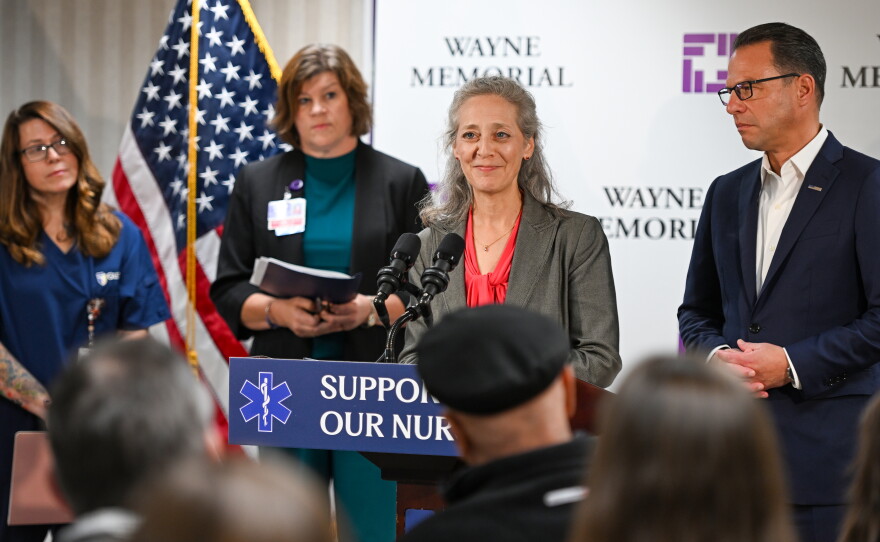
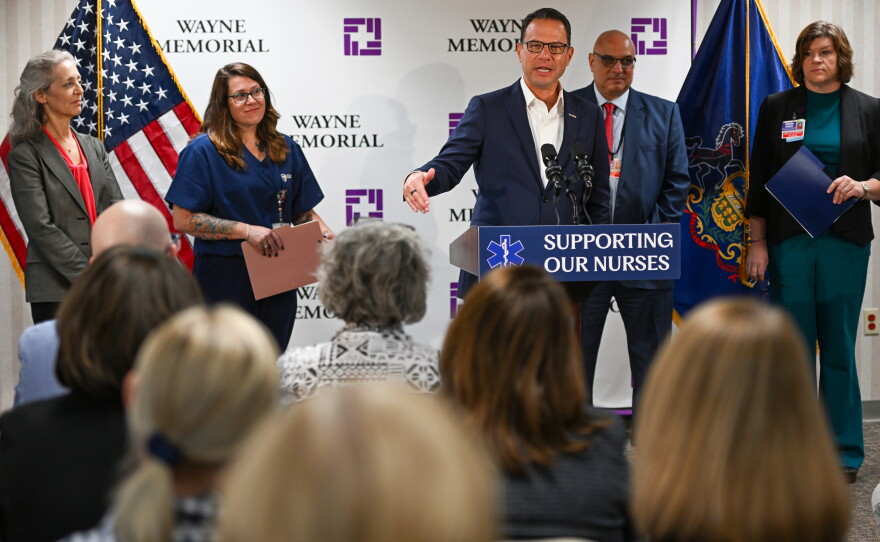
Gov. Josh Shapiro visited Wayne Memorial Hospital in Honesdale Tuesday with state health Secretary Dr. Debra Bogen to officially launch the Nurse Shortage Assistance Program, or NSAP, a way for hospitals to combat the nursing shortage with a student loan repayment incentive.
Pa.’s Nurse Shortage Assistance Program
According to the Hospital and Healthsystem Association of Pennsylvania, hospitals across the state face average nurse vacancy rates of 15%, and those numbers are often worse in rural areas.
“Here at Wayne Memorial, it stands at 25% and it represents 30 full-time and part-time nursing positions that are vacant or need to be filled,” Shapiro said.
And by 2028, the Association expects a shortage of 22,000 nurses in Pennsylvania.
The Nurse Shortage Assistance Program, a $5 million part of Shapiro’s 2025/26 state budget, provides funding to hospitals to recruit and retain nursing staff with student loan repayment assistance and partnerships with nursing programs across the state. Nurses will be eligible for up to $60,000 in loan repayment assistance over a three year commitment.
“The Nurse Shortage Assistance Program that I am here today to launch will contribute $10,000 a year per student, and the hospital that they work for will then match that number to combine forces and help create more opportunities for nurses in Pennsylvania,” Shapiro said.
Shapiro cited this program as just one of the ways his administration has worked to combat nursing shortages, including speeding up the nursing licensure process, limiting noncompete clauses for the state’s health care professionals and more.
“It's good for nurses. It's good for hospitals, and it is good for patients. And of course, it is good for Pennsylvania. In the first year, we expect about 200 nurses will be part of this program at hospitals all across our Commonwealth, and that number will ramp up as more and more hospitals sign up,” he said.
Building strong rural health care workforces
Bogen said this program proves especially important for the state’s rural hospitals.
“In many of our rural communities, a single hospital, a clinic, or a community health center serves as the entire healthcare backbone for miles and miles. And when those facilities are understaffed, families face longer travel times, delayed preventative care, and overburdened care teams,” Bogen said.
Shapiro said the initiative should help rural hospitals with recruitment and retention efforts.
“We'll get a stronger pipeline of well-trained nurses taking jobs here in local hospitals. It's a big deal, especially for our rural communities that I know have had challenges with their recruiting, and it reduces the financial barriers to entry for folks who have a passion for nursing but maybe need a little bit of extra help to bridge that gap and get them there,” he said.
Bogen said a strong rural workforce is important in the face of public health crises, like the state’s current measles outbreak.
“Combating measles like that requires rapid identification, early intervention, vaccine education, and direct community outreach. Having qualified, trusted nurses on the ground in every corner of Pennsylvania is a key line of defense,” she said.
The Shapiro administration sees this investment into the state’s health care workforce as an investment into some of the state’s most vulnerable communities.
“By investing in our nurses, we are investing in the health, safety, and future of rural Pennsylvania,” Bogen said.