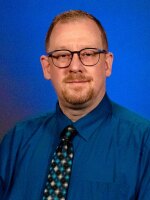
Journalists and documentary filmmakers have many skills in common, but perhaps chief among them is knowing how to listen.
Robert May found it essential in weaving together the stories told in "Bucks County, USA."
IF YOU GO
WHAT: Bucks County, USA preview screening and panel discussion
WHEN: Thursday, Nov. 19, 2026
WHERE: WVIA Public Media studios, 100 WVIA Way, Pittston, PA 18640
TICKETS: Free via this link
PANELISTS: Filmmaker Robert May, documentary participants Lela Casey and Vonna DeArmond.
MODERATOR: Julie Sidoni
"It is absolutely the process that we used in creating this story — to listen generously, and with respect, and allowing people to make their point," said May, who is based in Northeast Pennsylvania.
He and Barry Levinson are the award-winning filmmakers behind the new five-part series currently airing on PBS stations, including WVIA.
Filmed over four years starting during the COVID-19 pandemic, it focuses on friendships in the Pennsylvania swing county, looking "beyond politics to offer an impartial, human perspective on a deeply divided community," filmmakers say.
May will take part in a Nov. 19 panel discussion about the film and preview at the WVIA Public Media studios.
He spoke with WVIA News about the project and its origins — and how the art of listening is one he hopes people will appreciate more deeply after watching the series.
"One of the things we're really promoting is you don't have to agree with the other side politically, but having respectful conversations, listening generously to someone from the other side, which is something that is really hard for everybody to do these days," May said. "Because as soon as one person starts talking, the other gets ready to fire back, and they're not listening anymore at all."
Our conversation has been edited for length and clarity.
Q: What inspired this project? How did it come together?
A: During the pandemic, back in 2021, my wife and I couldn't go anywhere. We would drive around the hinterlands of Pennsylvania, and we would drive through McDonald's in the morning and get Egg McMuffin sandwiches, and then drive and just be out in the country.

When I saw the level of division that we encountered — the signs and that sort of thing — it was really striking.
I said to my wife then, I would love to be able to talk to people from both sides, and see why they feel the way they feel, why their opinions have led to such hatred and such awful things against the other side.
But it was like, well, I'm not sure anybody would want to see that, and I sort of let it sit.
But then my producing partner Jason Sosnoff — who is also Barry Levinson's producing partner — he and I were talking about a different project, and in the process of talking about a different project, he said to me, "You know, I have an idea."
He wanted to do something about the division. And so we put our ideas together, and we thought, what if we did a documentary where we talked to people from both sides and talked about why they feel the way they do.
And then when Barry Levinson started to weigh in, he suggested that we stick to one town somewhere in the U.S. rather than go to a bunch of different towns around the country — you know, pick an idyllic town and go there and really be curious about why people were feeling the way they are there.
So from there we said, okay, well we need to pick a town.

Q: What led you to Bucks County?
A: Jason saw the New York Times Daily podcast on school board wars in Bucks County — actually we both did, but Jason was the first to see it.
They picked Bucks County because it was really going haywire there, where parents were coming to school board meetings from the right and the left in the name of their children, talking about how the other side is doing such great harm to their children.
And so he and I went there and we talked to a few people. We did sort of a tour of the town or the area — because Bucks County is a region really, but there's a lot of little towns. We spent a lot of time there, and then we decided we would we would give it a try. We began filming in April of 2022.

Q: Did you interact with folks who were directly impacted by some of those heated school board debates?
A: We spent over 100 days filming and more days in research over the four years, and we interviewed many more people on camera than are in the series — both people from the right and people from the left.
What we did know initially, by the way, is that what was happening in Bucks County wasn't an anomaly. It was happening in towns across the country where parents were coming to school board meetings, and they were bringing all the national issues into the school board meetings, and to some extent, kids were at the center.
So yes, we we were able to talk to many people on both sides, and the first challenge to that, of course, was getting people to trust us. Typically people on the right didn't trust us at all because they viewed us as the media or movie makers or Hollywood or whatever — however you want to say it — where people on the left were more open to to talk with us.
So we had to convince people. Getting those first few people on each side to trust us was the hardest part in the beginning.
We're not making a reality show. We never take commentary out of context. We're very careful to be sure that we follow the track and the intent of the people that are talking with us, and keep everything in context.
Once we did that — and once they realized, oh, we're like the real deal, and we're making a real story, we're not making a reality show — eventually, we gained the trust.

Q: How did your interview process reinforce their trust?
A: Our process of interviewing is strategic, but it's also very lengthy. Our master interviews are three hours long, sometimes four.
And with the setup on either side and wrap, you know, we're in their house for five or six hours the first time. And over the course of time and multiple interviews, you gain trust both ways — it allows us to see who these people really are as we select which participants are going to end up in the series.
Q: How did you balance the interviews to give everyone a fair say?
A: So I might be talking to someone from the right in the morning who is bashing the left, and I might be talking to someone then in the afternoon from the left that's bashing the right.
We, as a team — we had a pretty sizable crew, six seven people — our job was to listen generously, and to ask the questions we felt were important, and not interrupt their response. Let them let them present to us why they feel the way they do. And so, you know, we heard it all. We heard it all from both sides.
Q: These people of opposing views, do many of them know each other?
A: Well, they do, and I think there's no better example than the two girls, both 14-year-olds at the time, teen girls Evi and Vanessa, who lead us through the whole story.
They themselves differ politically. They have strong political differences, really, but they're best friends. Their parents are absolute enemies, as you'll see in the in the series, but yet they allowed their two daughters to be friends, to be best friends.
So that in itself is remarkable to me because I know there are many families that will not let their children be friends with anyone from the other side, which is sad. So you know these were good people with very differing points of view.
Q: Did you find that anyone's views changed in the course of the project?
A: I would say from a political point of view their politics didn't change, but I do think their view of the other side started to soften. Now, whether the project had to do with that or not, I don't know.
OTHER COVERAGE
From our partners at WHYY:
● New documentary series examines the personal side of political division in ‘Bucks County, USA’
● The making of “Bucks County, USA”
But for two key characters in the series, Kitty Semisch and Vonna DeArmond, who were both teachers, they began a friendship based on Kitty approaching Vonna after a school board meeting.
Vonna was a teacher that's more conservative. Kitty was a teacher that's more liberal.
We had been talking with Kitty already. We knew of Vonna, but we hadn't put them together in any way. We didn't realize they were talking to each other, but when we did, we asked if we could be part of their journey over that four-year period, and they agreed to let us in.
And so there's a lot of scenes with Kitty and Vonna in it where they come together and they try to talk about their differences. And what you can see happen in that time frame is that their admiration and respect for each other is growing in front of our eyes.
When we decided to do a student roundtable, where we had five students from the right and five students from the left, and we brought them into this roundtable, they needed to be moderated. So we asked Kitty and Vonna if they would moderate this student roundtable.
It was remarkable. The kids were remarkable. Kitty and Vonna did a great job of listening — generously listening — and that's the example that they set for us.

Q: What about the two teenage best friends?
A: They were best friends then and are still best friends today.
In fact, they unpack the entire series after the last episode, episode five. Judy Woodruff interviews the two teen girls about their experience in the series, and they unpack the whole series. People really need to watch that.
Q: The filming ran through 2025 — well past COVID. Why?
A: We cite COVID as a final inciting incident to the division. The division started well before COVID, but it reached new peaks during COVID when people were locked up in their houses, and and in particular in schools where parents were starting to monitor what was being taught in schools, and some of them were not happy with that.
It started out as a one-off documentary. We were just going to make a two-hour documentary. But when we were filming and realizing that there was so much material to tell a full story of what actually happened there, it needed to be a series, and so it then ended up being five episodes.
We also thought that we should take it through the [2024] presidential election without focusing on the presidential election. But it's a milestone in time that we felt we needed to go through, and we needed to see these characters in that scenario.
Q: Do you think the themes in this series will continue to be relevant five, 10, 20 years from now?
A: I hope not, but I think they will.
I mean that I don't think we're out of the woods. Yes, there was an election [midterm]. It was decisive. But you already see the animosity building up, and so who knows what's going to happen.
But the bottom line is — this is the way I look at it — when we attack or go after retribution from someone it certainly doesn't make you feel good in the long run. What are you trying to accomplish by belittling someone or dehumanizing somebody else? And if that continues to happen, society will break down in areas that we've never seen before.
So one of the things we're really promoting is you don't have to agree with the other side politically [but] promote generous listening and conversations that are respectful, which could apply to anything.
Q: Returning to the upcoming discussion, Kitty was supposed to participate, but tragedy prevented that. What happened?
A: Kitty was tragically killed in an awful accident in Bucks County.
We knew that Kitty would absolutely want this to continue without her and in her name. So for now the it's still called the Kitty-Vonna conversation, but Lela Casey, who's the mom of Evi Casey — sort of a younger version of Kitty and they were very close — is going to attempt to fill the shoes of Kitty.
Vonna was very welcoming to Lela to do this. So they have talked about how they're going to do it, and they both agreed they are going to do it in honor of Kitty.
We'll show a little piece that's dedicated to Kitty after we show the 30-minute preview. We'll talk about what happened to Kitty and her conviction to do this, and then we'll be moderated by Julie Sidoni, and then open it up to questions from the audience.